Your neutrals are good. The colours are right. Nothing is wrong, exactly — and that is the problem. Correct is not the same as considered. Here are the eight small decisions French women make to turn cheap-looking neutrals into something that reads expensive, using the clothes already in your closet.
Most women who love clean, neutral dressing are doing everything right — and still landing one step short of expensive. The pieces are good. The colours are correct. Nothing is wrong. And that, exactly, is the problem: correct is not the same as considered.
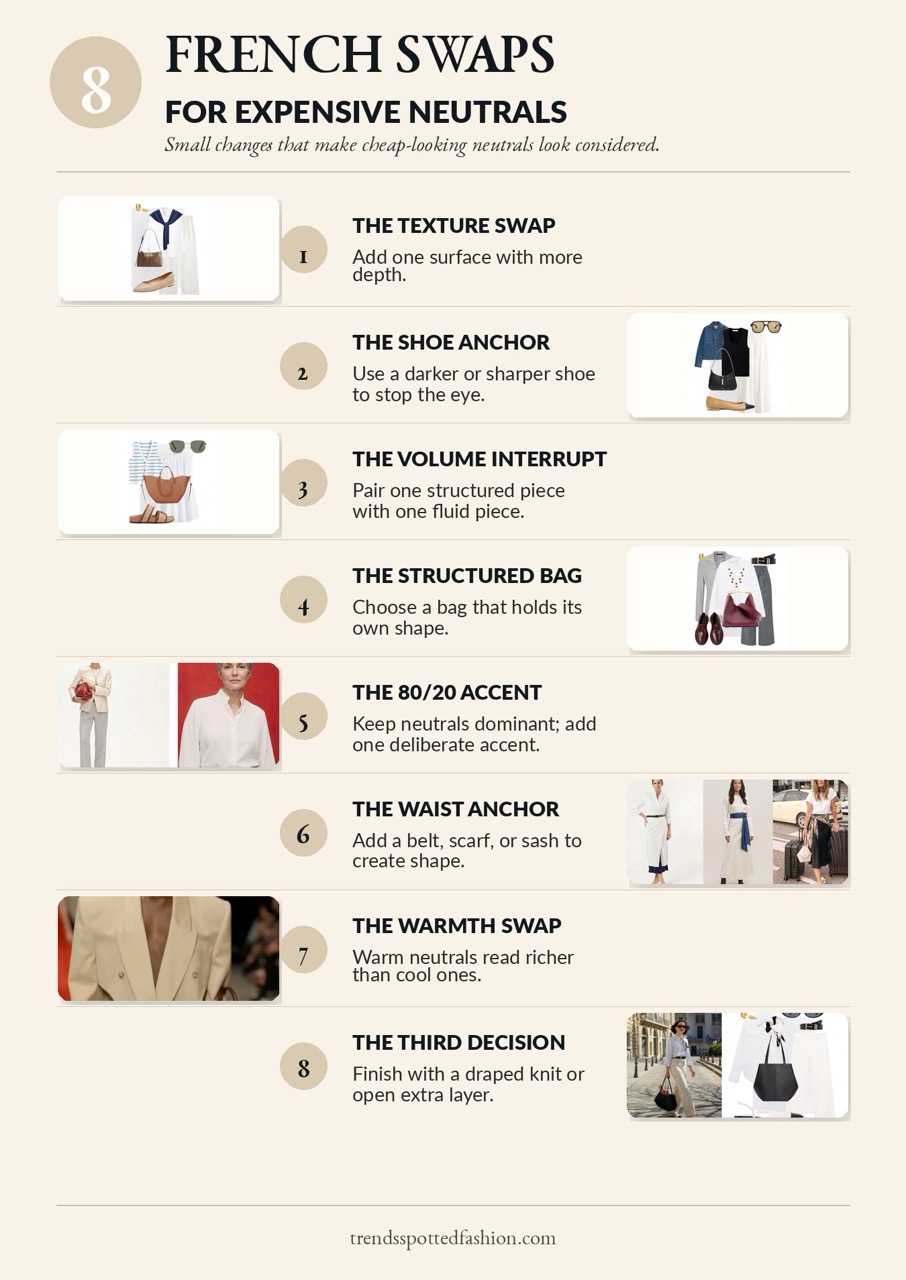
There are eight places where a neutral outfit either reads as chosen, or reads as the default the rack handed you. French women are not buying better neutrals than you. They are making eight specific decisions — and you can make every one of them with what you already own. None of it costs anything. None of it requires a single new piece. Here are the eight swaps, starting with the one your eye registers before anything else.
Swap OneThe Density Swap
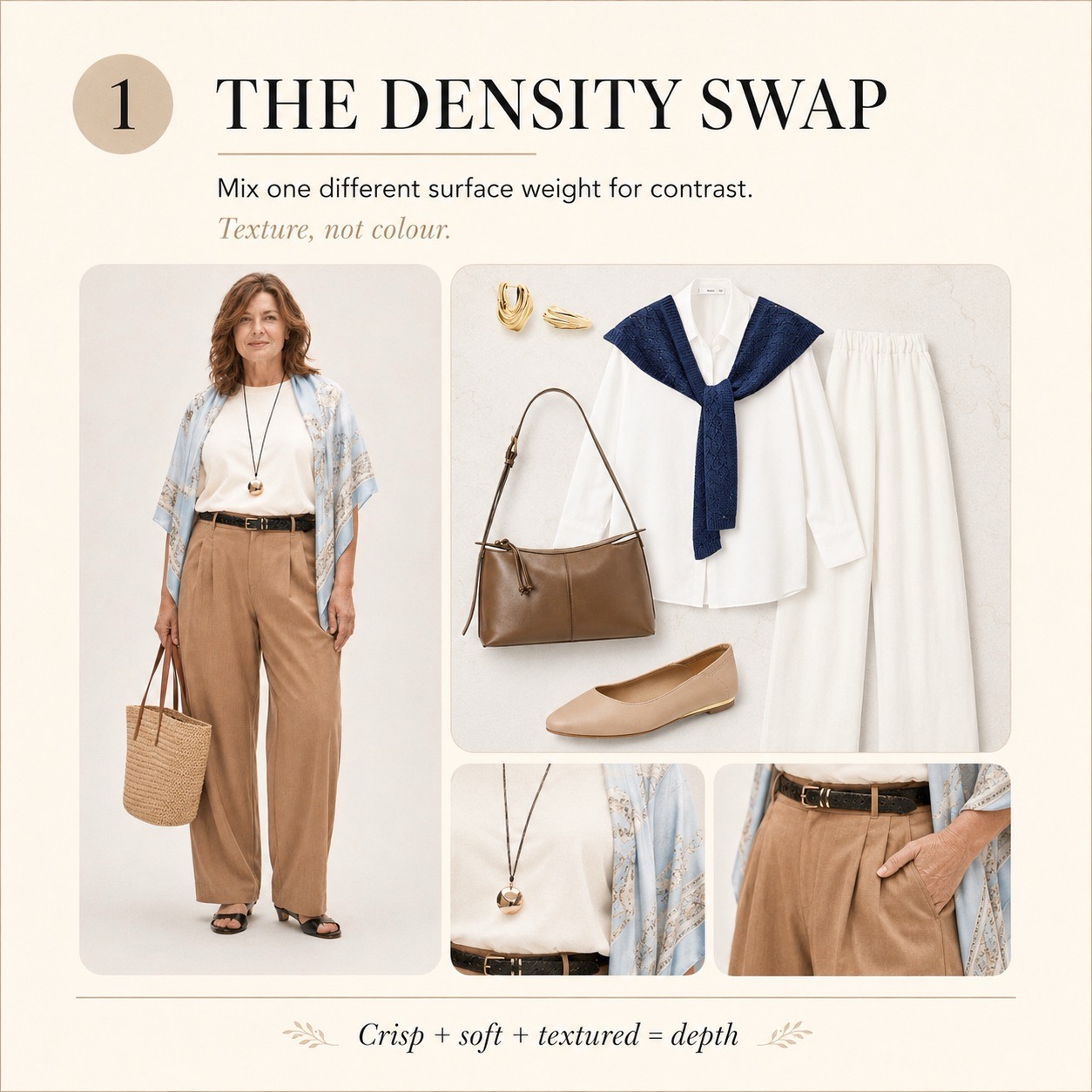
Most neutral outfits fail at texture, not colour. When every piece carries the same surface — flat top, flat trousers, flat bag — the eye has nowhere to travel, and one unbroken surface reads as unfinished. The fix is to introduce one piece with a different density. A fine knit vest over a crisp white shirt. A bouclé jacket, rough against smooth. Not for warmth — for contrast.
And here is how you know a fabric will carry that weight. Feel it first: natural fibres — cotton, wool, silk, linen — hold their finish. Check the seams: straight, no loose threads. Press the buttons and zips: solid, not hollow. Then stretch the cloth gently; good fabric returns to its shape. Quality is not a price. It is something your eye reads as depth before any label is visible.
Swap TwoThe Footwear Full Stop
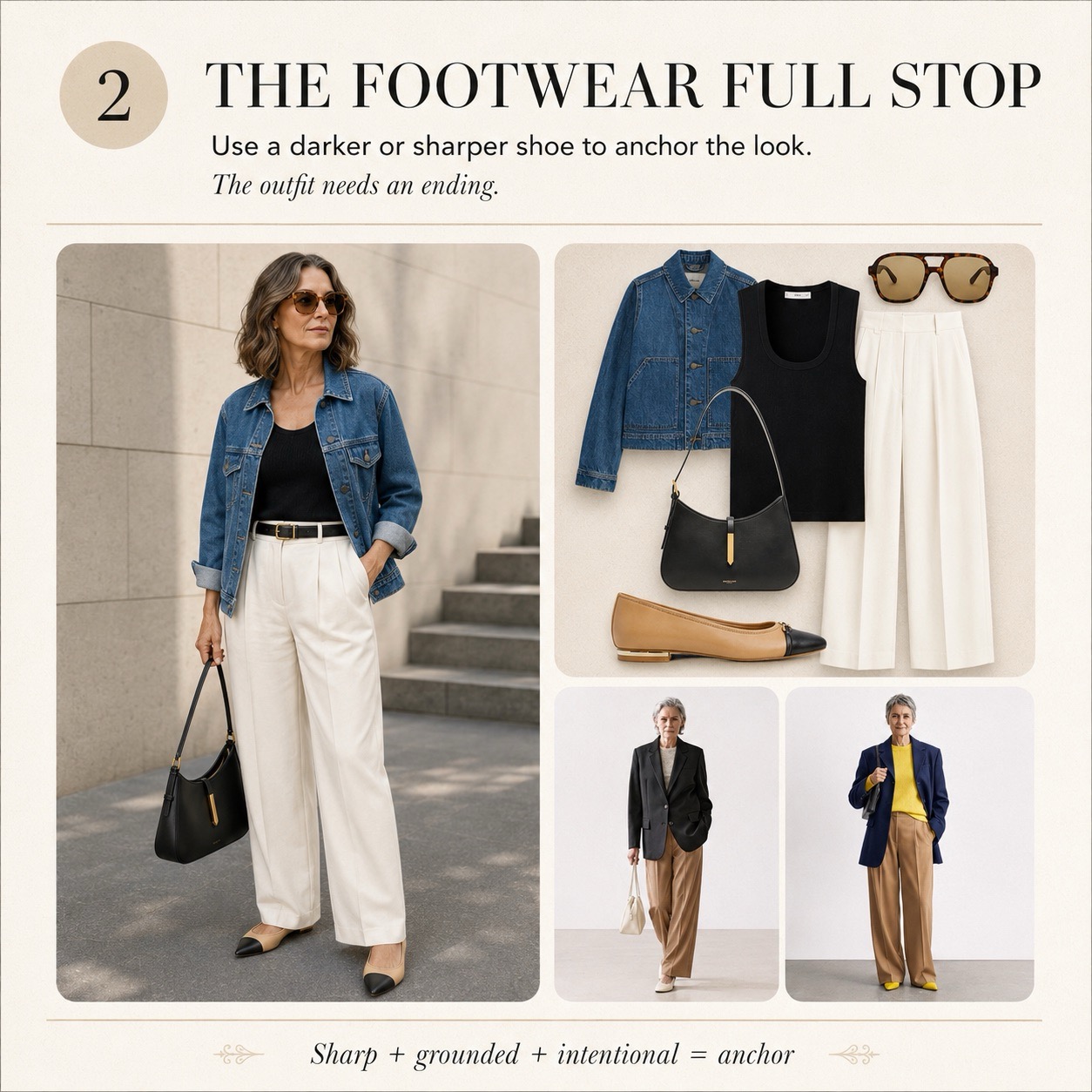
Safe shoes are one of the most common reasons a neutral outfit quietly disappears. Cream shoe, cream trouser. Beige on beige. The eye falls off the bottom of the look and nothing holds it. This is not a call for harsh contrast or dramatic shoes — when everything else is quiet, the shoe simply has to say something.
A pointed toe in a slightly deeper tone sharpens the line. A clean loafer adds quiet weight. A boot under a wide-leg trouser gives the outfit a clear ending. The mistake is never wearing simple shoes. The mistake is choosing a shoe with no point of view at all.
Swap ThreeThe Volume Interrupt
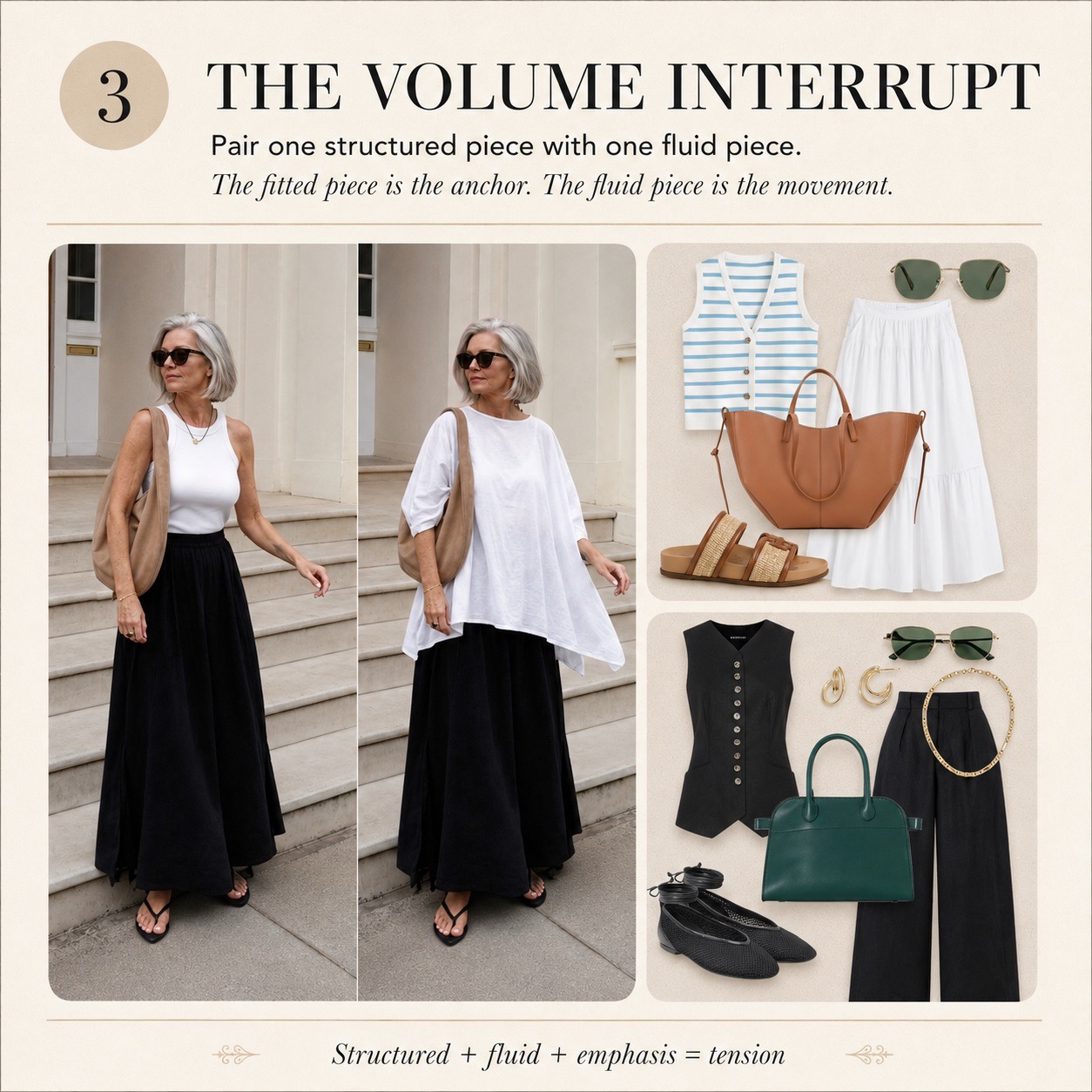
Most women style every piece at the same volume — a straight shirt with straight trousers, a relaxed blouse with relaxed jeans. When everything holds the same shape, the outfit loses tension, and tension is what holds interest. You have heard the advice to pair something fitted with something loose, and it works. But proportion is not only about balance. It is about emphasis.
Before you play with volume, decide what you want to draw the eye toward, and what you want to soften. Then the formula earns its place: a tailored waistcoat over wide-leg trousers, a cropped knit over a long, fluid skirt. The fitted piece is the anchor. The fluid piece is the movement.
Add your email and I’ll send the free guide, plus a short series of style notes to help you dress with more ease and elegance. Already subscribed? You don’t need to sign up again.
Swap FourThe Structural Mass Rule
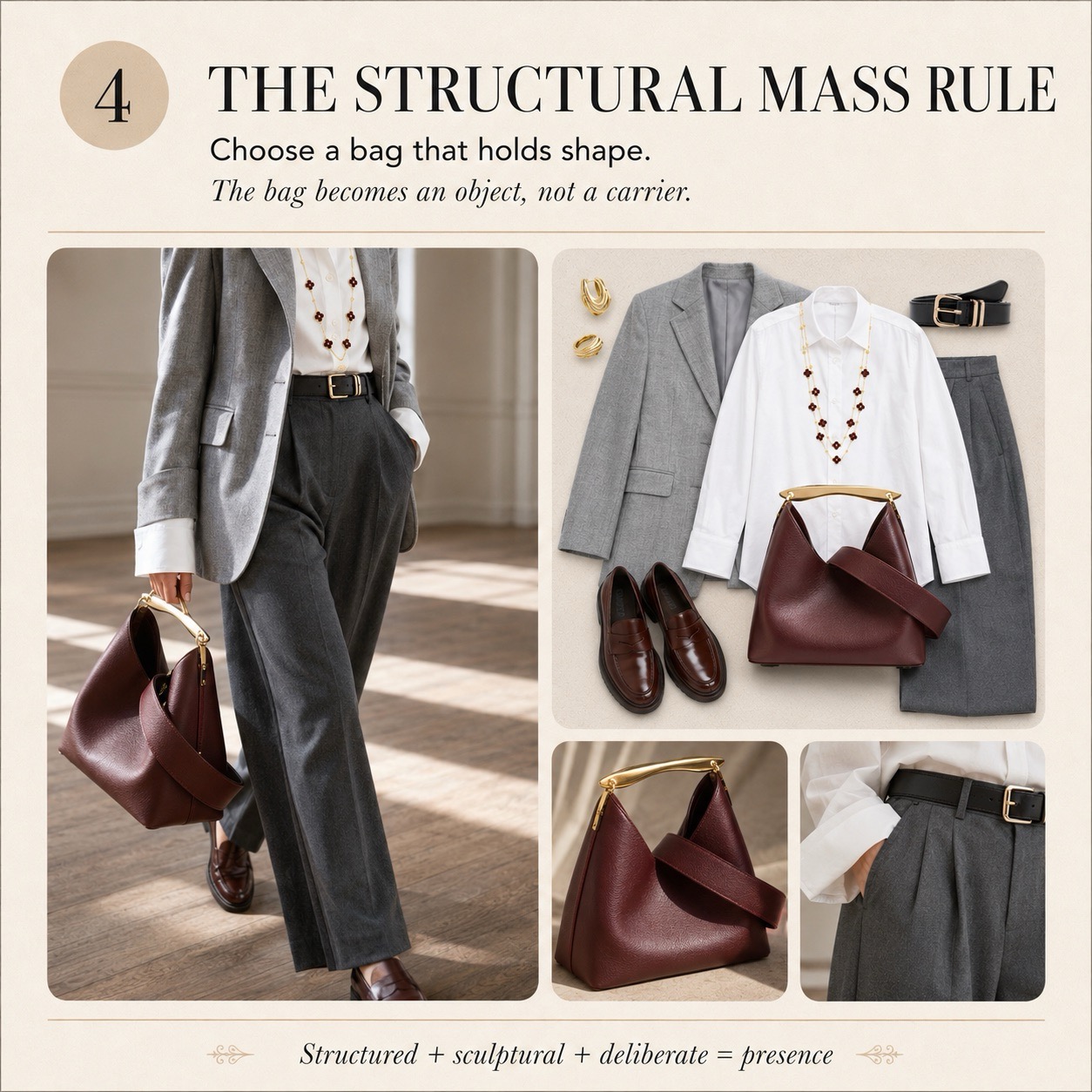
A soft, formless bag collapses an outfit. A canvas tote that flops. A cross-body that leans against the hip. Fine on their own — but next to a considered outfit, they read as an afterthought. The swap is structural mass. A barrel bag holds its cylinder. A firm basket, a structured satchel — they add a three-dimensional shape no flat piece can.
The bag becomes an object, not a carrier. And that distinction is the whole line between an outfit that is assembled and one that is styled.
“Quality is not a price. It is something the eye reads as depth, long before any label is visible.”
Swap FiveThe 80/20 Signal
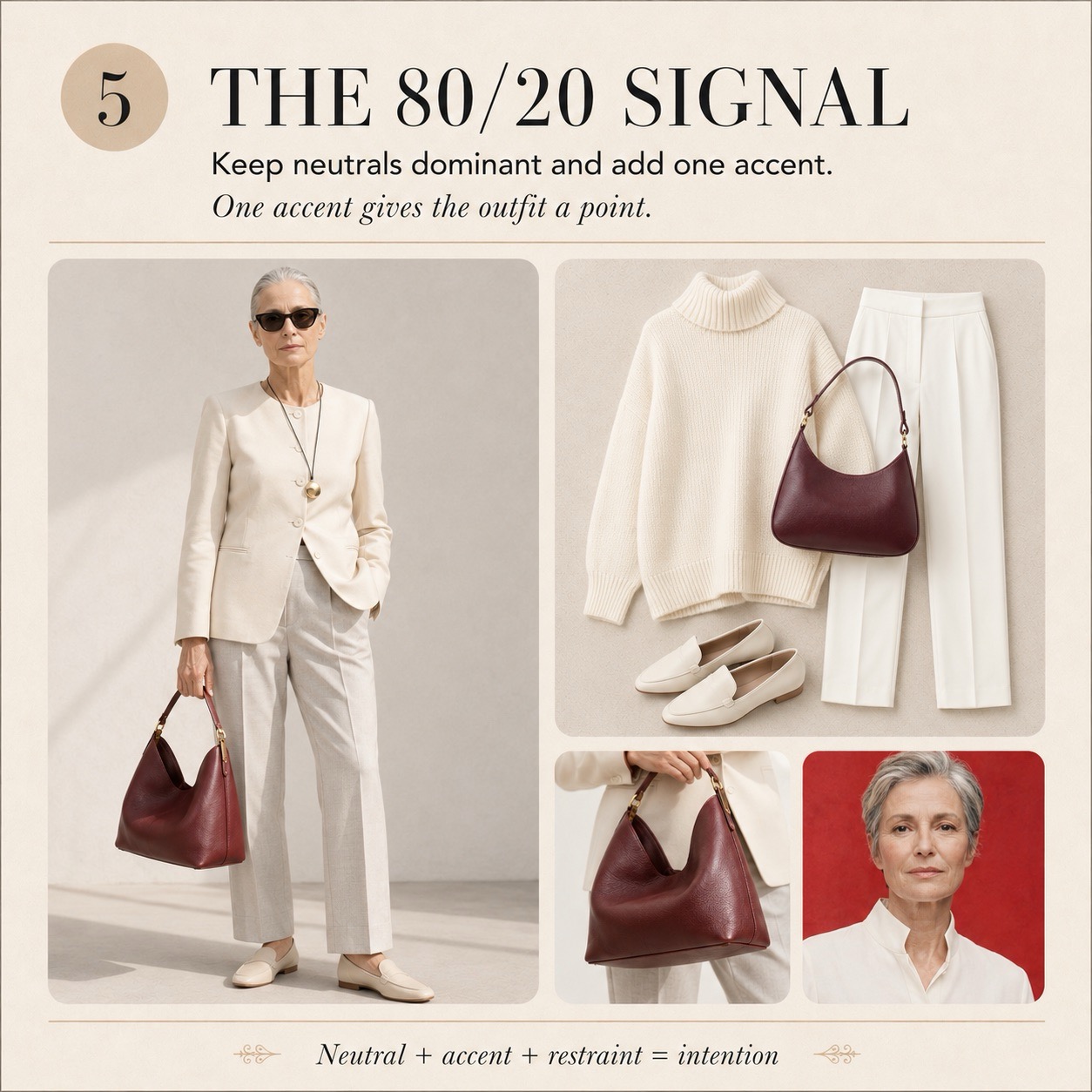
Head-to-toe neutral is the most misunderstood version of this. It looks complete — but it reads as absent. All beige, all grey, without a single departure, and the outfit says nothing. The rethink is roughly eighty per cent neutral base, twenty per cent one deliberate accent. A single ox-blood bag. A deep green belt. One piece the rest of the outfit orbits. That one accent is what makes a neutral look chosen, instead of default.
And the instinct is more precise than people give it credit for. So many of you have said the same thing: the red bag felt right, but the red shoes tipped it into too much. That is exactly the read. A neutral outfit rarely needs more. It needs one thing that gives the rest a point.
Swap SixThe Waist Anchor
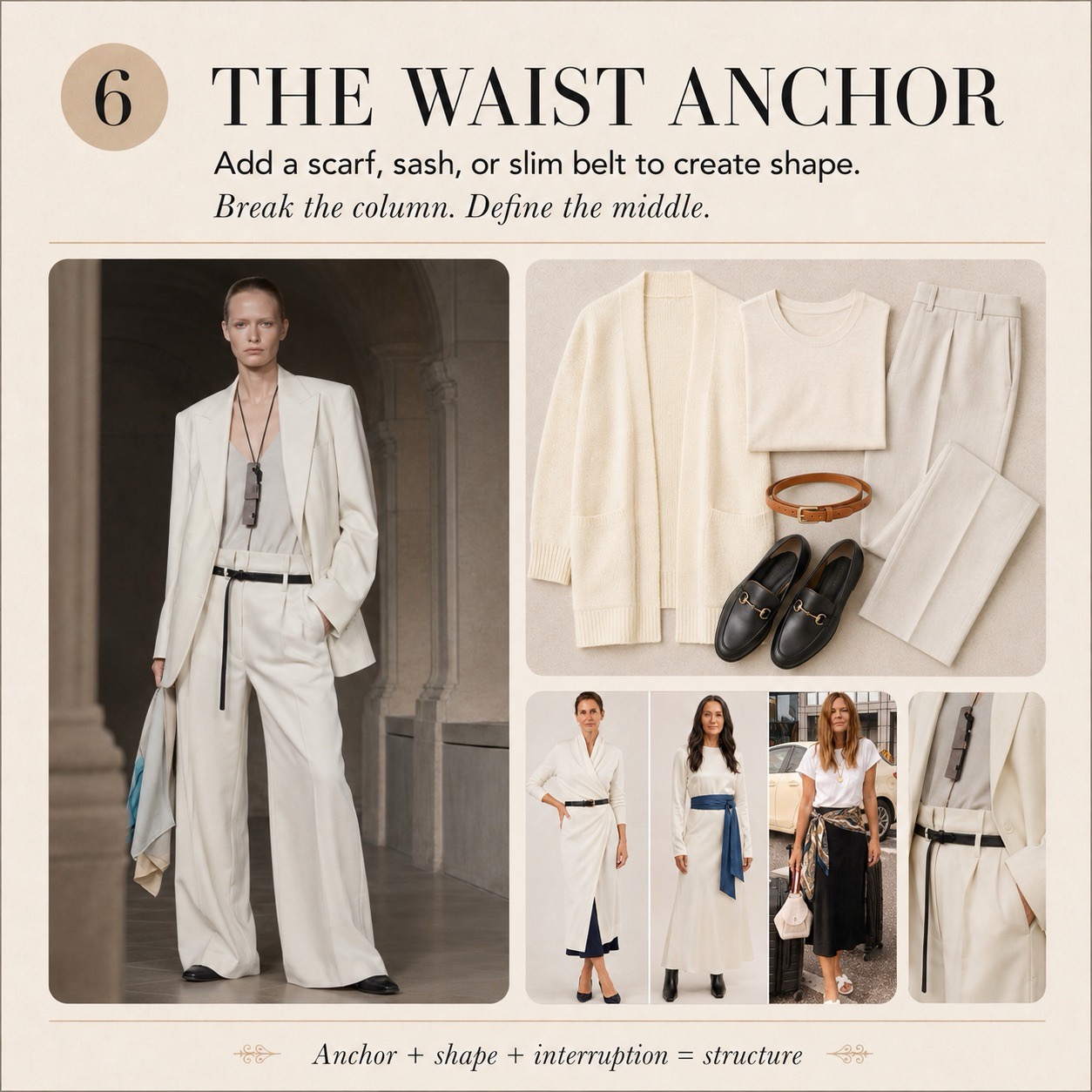
Sometimes the outfit is not failing because it is loose. It is failing because nothing holds the middle. Wide-leg trousers and a relaxed blouse, worn together with no waist point, read as one uninterrupted vertical column — and the eye sees the body as a single block. This is not a volume problem. It is an architecture problem.
The fix is simple: introduce a waist point. Not tight, not cinched. Just present. A silk scarf tied loosely at the waist. A slim leather belt over a long cardigan. A soft sash, double-wrapped. That small anchor breaks the column into a top and a bottom, and the outfit immediately reads as shaped, rather than draped.
Swap SevenThe Warmth Gradient
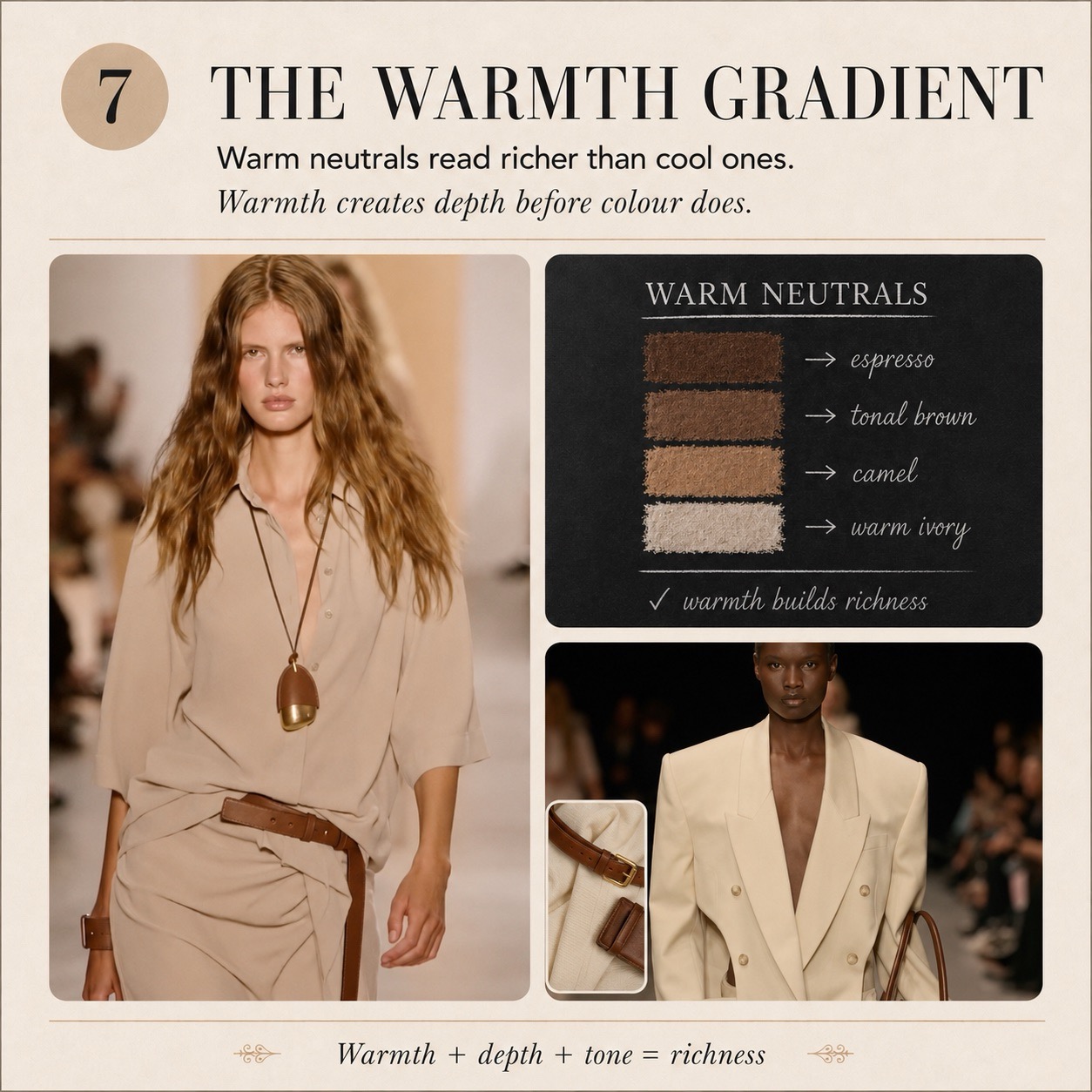
The temperature of a neutral is one of the most powerful signals most women never use on purpose. Cool neutrals — icy grey, stark white, cold beige — read flat. They are the colours of a waiting room. Warm neutrals — espresso, tonal brown, camel, warm ivory — read rich. Still minimal, but considered. The difference between an outfit that looks expensive and one that does not is frequently just this: whether the neutrals have warmth in them.
And this is not only an eye trick. Industry analysts — in the Business of Fashion and McKinsey State of Fashion report — have found that quality is now the single strongest driver of whether something reads as high-end, ahead of the brand and ahead of the price. Depth and warmth are how quality reads from across a room, before anyone is close enough to check. You do not need colour. You need depth. Colour is optional. Depth is not.
Swap EightThe Effortless Third
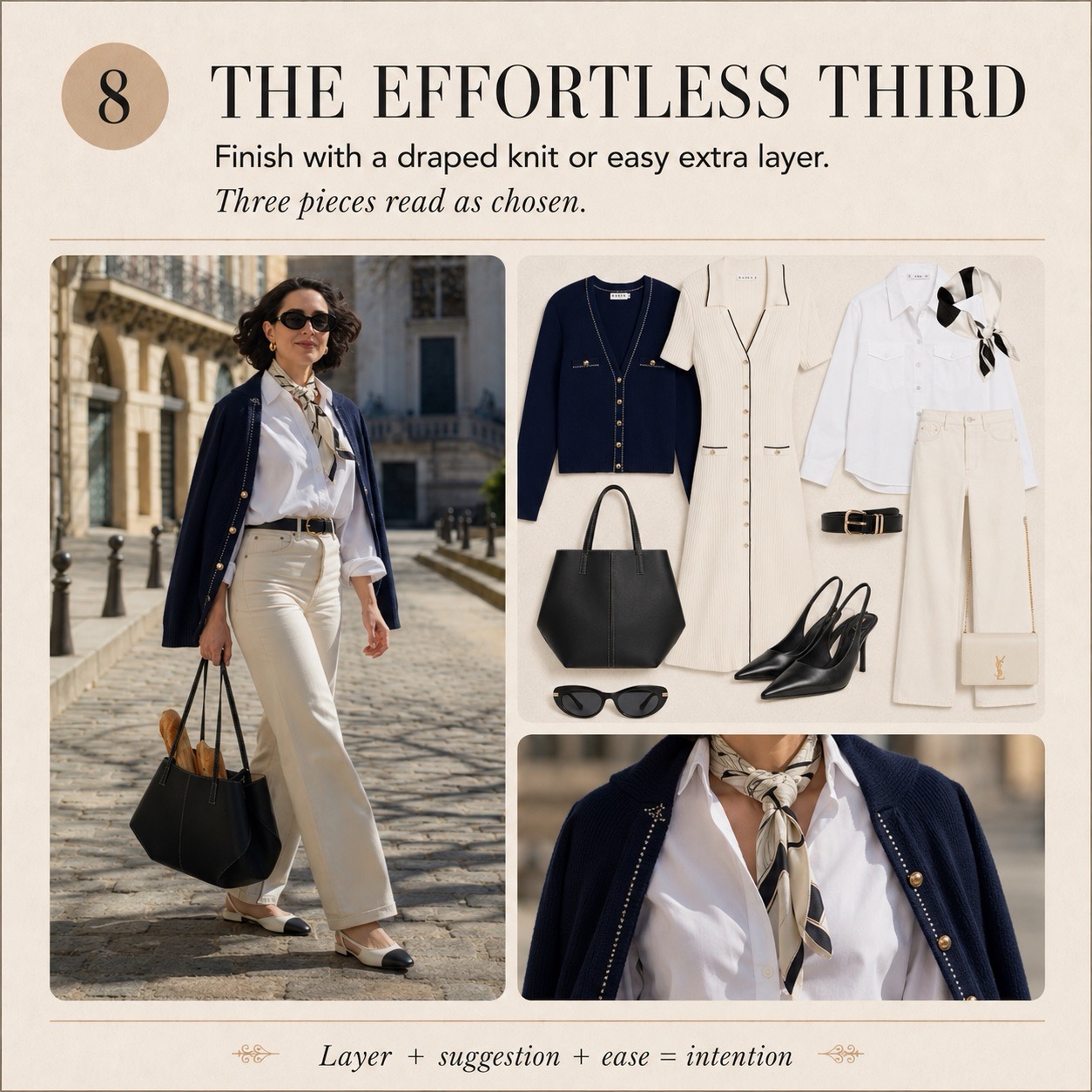
A two-piece outfit, even a perfect one, can look finished — and finished is not the goal. The goal is to look as though she was choosing anyway. Two elements read as accidental. Three read as chosen. There is research behind the feeling: what we wear changes not only how others read us, but how we carry ourselves — and the third piece is where that lands.
It is never the star. A sweater tied loosely at the shoulders. A trench worn open, barely draped. A bouclé jacket, half on. The third piece is the suggestion of a thought — the thing that makes an outfit look like it belongs to a life, not a concept. And it does not have to be expensive. The third decision does the work, not the price tag.
The thing underneath all eight
One thing sits beneath every swap above: none of them land on a piece that does not fit. Off-the-rack neutrals are cut for a sample body — usually one twenty years younger than the woman buying them. A sleeve that breaks at the wrong point. A blazer that will not sit at the waist. A hem a centimetre too long. That is what makes an expensive piece look like the wrong piece.
So before the next purchase, run one test: does this need a single alteration to sit right? If yes, factor it in. A €60 trouser that fits exactly beats a €200 trouser that almost does. The fit problem was never your body. It was the clothes.
Eight swaps. Not one of them requires a new piece. All of them change what the outfit says before anyone is close enough to read a label. And that is what expensive actually is — not a price, not a name, but a set of decisions, made with clarity, and worn without explanation.
The Elegant Wardrobe System walks you through building a settled, personal wardrobe from what you already own — the same clear thinking behind all eight swaps above.
Get the Elegant Wardrobe System — $49
Not sure where your neutrals are losing it? Take the free quiz:
References to French dressing and to individual creators are for commentary and analysis. The street-style reference in Swap Eight is via @melodiebanfield (“6 neutral outfit choices that look dated”); all other imagery here is original or properly licensed. This post contains no affiliate links.