Looking expensive after fifty is not about buying more, or chasing whatever the season has decided is new. It is about a few clear decisions that make simple clothes read as considered instead of cheap. I put the five rules from the video onto one printable page, so you can save them, screenshot them, and use them the next time you are standing in front of your wardrobe.
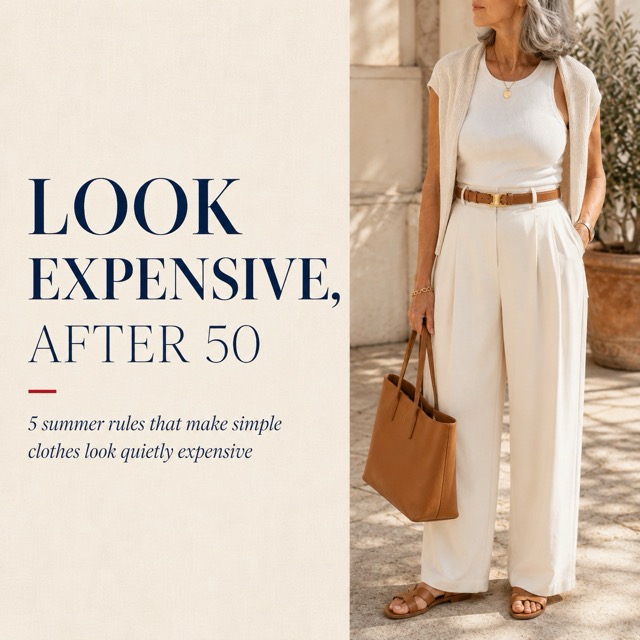
There is a specific way summer dressing goes wrong. The weather turns hot, the wardrobe gets simpler, and the outfit tips into either too plain or too practical. A dress with no shape. Linen that creases in the wrong place. A comfortable shoe that undoes the whole line. Nothing is technically wrong — but the look starts to read as cheap rather than considered.
The answer is not to add more. It is to make fewer, better decisions. One colour family. One piece allowed to speak while the rest stay calm. One shoe that sets the tone. One long line from shoulder to shoe. One good bag doing the work of five trends. Chosen well, plain clothes stop looking plain and start looking expensive.
That is why I put together this printable edit: the five rules from the video, placed on one page you can actually use. Keep it on your phone, print it for your wardrobe, or run it as a quick check before you get dressed.
All five rules from the video are placed on one printable page — so you can save them, screenshot them, or keep them on your phone for the next time you get dressed.
Rule 1 — Stay in one colour family
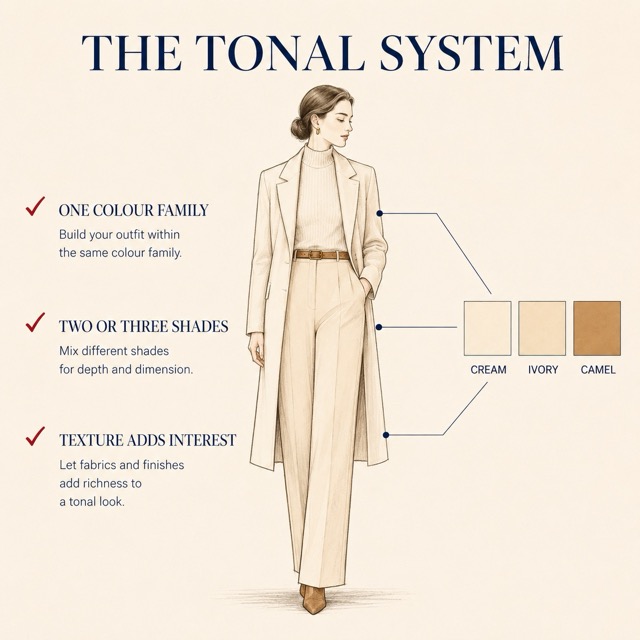
The fastest way to look expensive is also the simplest: keep everything in one colour family. Cream on cream. Navy on navy. Soft blue on white. When the whole outfit sits within two or three shades of each other, the eye travels from shoulder to shoe without stopping — and that unbroken line is what reads as considered.
The mistake is reaching for contrast: a different colour on top, on the bottom, on the feet. Every break makes the outfit look busier, and busier reads as cheaper. Build from one shade, and let texture — linen, knit, suede, silk — do the work a second colour would only interrupt.
Rule 2 — Let one piece be loud, keep the rest quiet
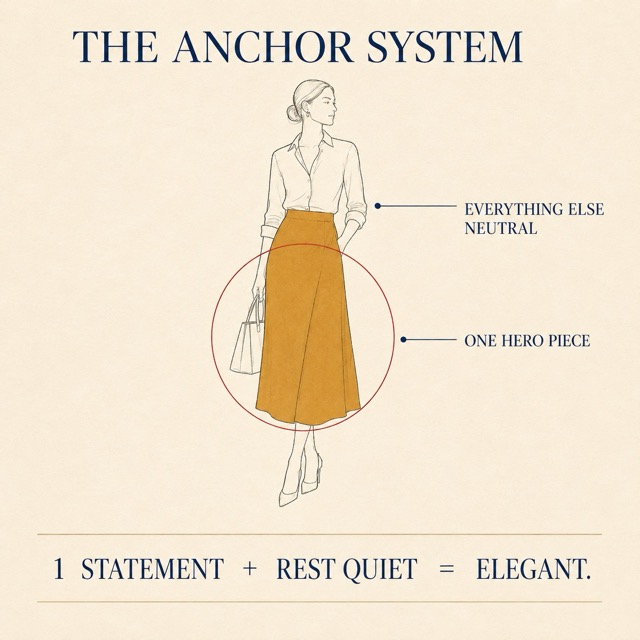
Colour is not the enemy. Too many colours at once is. The elegant way to wear a bold piece — a mustard skirt, red trousers, a printed dress — is to let it be the single statement, and calm everything else right down. One hero, everything else neutral.
When three pieces all compete to be the star, none of them wins and the outfit reads as trying too hard. Choose the one thing you want noticed, and let the rest disappear behind it. That restraint is what turns a strong colour into elegance instead of costume.
Rule 3 — Let the shoe set the price
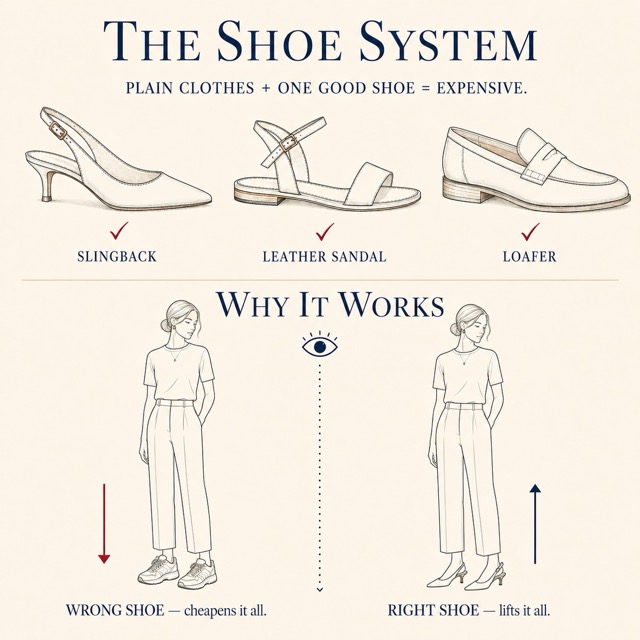
The shoe is the first thing that tells the eye how much an outfit cost. Plain clothes with the right shoe look expensive; the same clothes with the wrong shoe look like an afterthought. After fifty, three shapes do almost all the work: a slingback, a good leather sandal, and a clean loafer.
They finish tailoring, sharpen white linen, and ground a summer dress. This is the highest-value decision in the whole outfit — buy one very good pair and let it carry the simple things.
“The goal was never to chase the next thing. It is to build a way of dressing that trends cannot shake.”
Rule 4 — Build one long vertical line
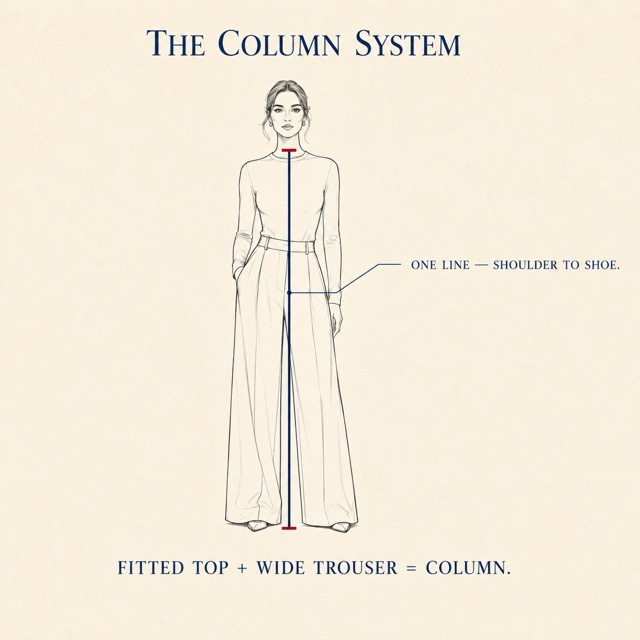
Proportion is quiet, but it changes everything. The mistake is breaking the body in half — a hard colour change or a heavy edge right at the waist — which makes you look shorter and the outfit heavier than it is.
The fix is one unbroken line: a fitted top over a wide trouser, a slip skirt, a single-colour column dress. The eye runs from shoulder to shoe without a stop, and the whole look reads longer, calmer, and more expensive. Half-tuck to mark the waist if you like — then let everything fall straight.
Rule 5 — One good bag beats five trends
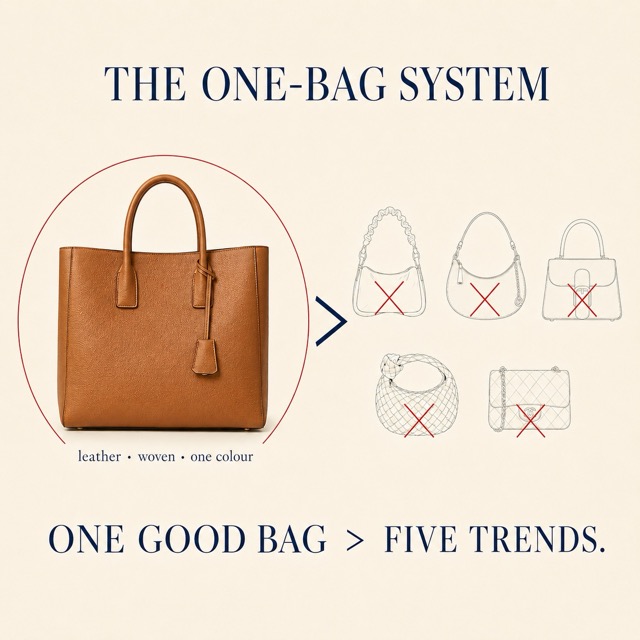
The bag of the season changes every season, and chasing it is how a wardrobe always feels slightly behind. One considered bag does the opposite: it carries a plain shirt and jeans further than any trend could.
A soft leather shape, a woven tote, one clear colour — the clothes stay simple, and the bag becomes the piece with a point of view. Invest in one you genuinely love, and let it do the talking for years.
What is inside the printable edit
Inside the printable, you will find all five rules on a single page, each with the pieces that carry it: the colour families that always read expensive, the one-anchor formula, the three shoe shapes worth owning, the column proportions that lengthen the line, and the bags that hold their value. It is built to be used, not read once and forgotten.
Five summer rules on one page · the colour families that read expensive · the one-anchor formula · three shoe shapes that always work · column proportions for a longer line · the bags worth owning · simple styling notes for women over 50.
Use it three ways. As a packing page before a summer trip. As a wardrobe reminder on the days nothing feels right in the heat. And as a quick styling check: does the outfit have one colour family, one anchor, the right shoe, one long line, and one good bag?
Want the full method behind the rules? The Elegant Wardrobe System walks you through building a settled, personal wardrobe from what you already own — so colour, proportion, and balance all work together, not just in isolation.
Get the Elegant Wardrobe System — $49
Not sure what is making your outfits fall flat? Take the free quiz:
References to designer pieces and summer styling are for commentary and wardrobe education. All imagery is used for editorial inspiration and guide promotion.