
Style · 8 min read
Here is something nobody tells you. The women you look at and think she has money — half the time, she doesn’t. Not the way you imagine. What she has is control over five small things.
And once you can see them, you cannot un-see them.
None of this is about spending more. You can spend a fortune and still read cheap. You can spend almost nothing and read like the most put-together woman in the room. The difference is not the receipt. It is the detail.

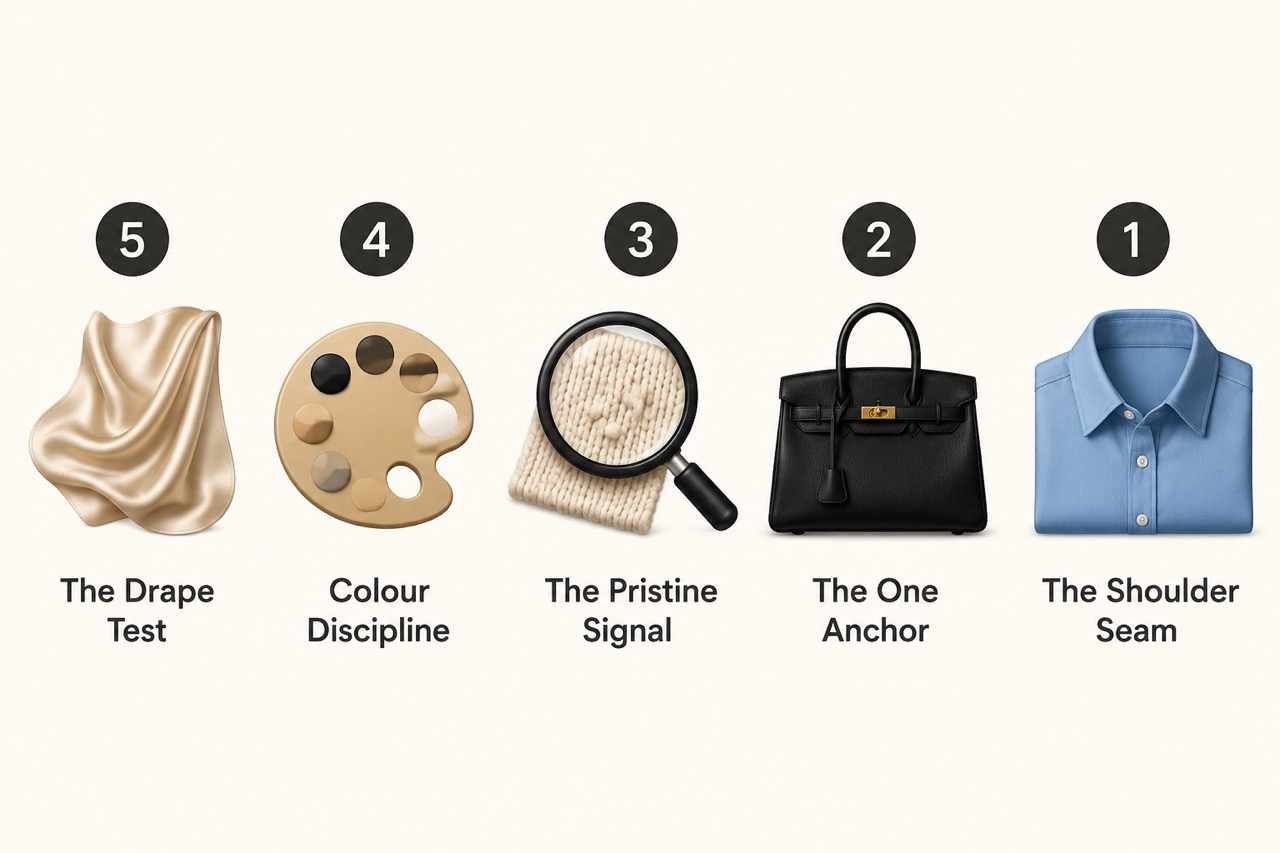
Five details. One shift in how you see clothes — forever.
Let’s go through all five — counting down to the one that matters most.
5. The Drape Test — Choose Fabric That Falls
Pick up almost any outfit that reads cheap, and the fabric is doing one of two things. It is either stiff and standing away from the body, or shiny in that hard, plastic way that catches light wrong. It wrinkles into sharp creases. It clings where it shouldn’t.
Now watch expensive fabric. It falls. It moves with her when she walks. A silk slip dress, a satin trouser, a suede jacket, a soft linen — they all share one thing: weight. They respond to gravity the way natural fibres do.
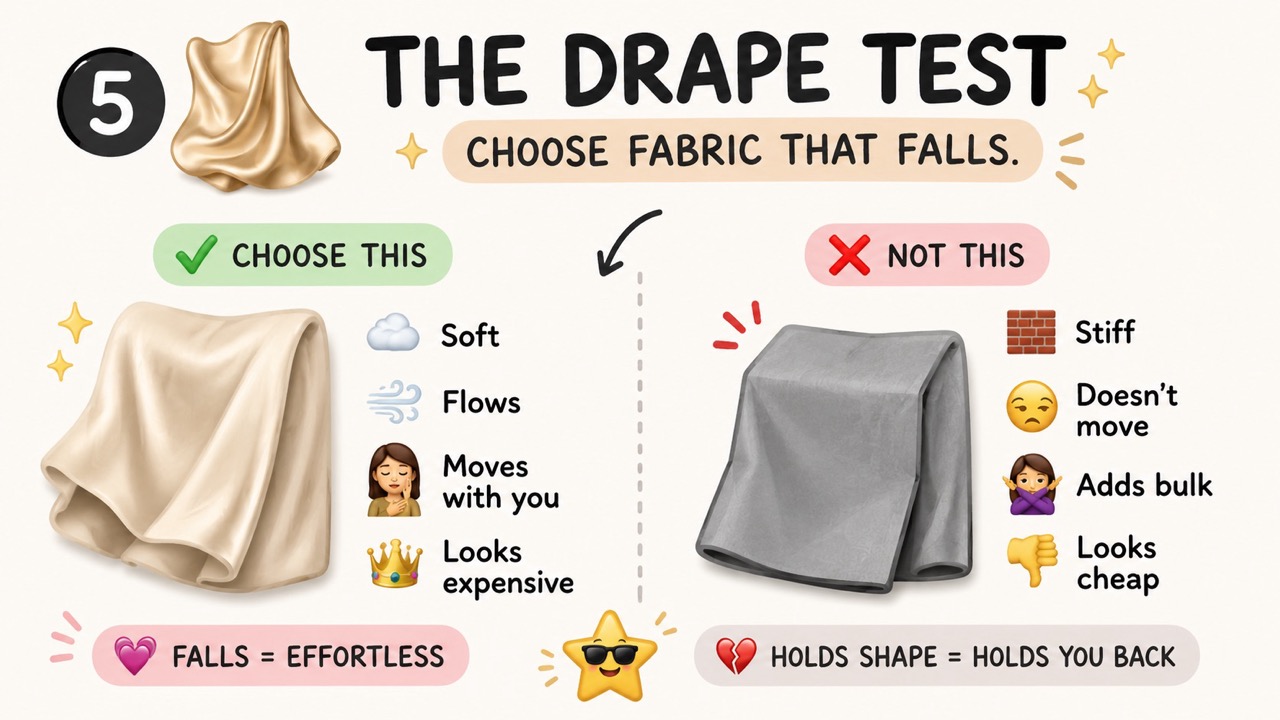
Falls = effortless. Holds shape = holds you back.
Here is why your eye knows the difference before your brain does: we are wired to read how cloth behaves under gravity. Movement and weight signal a natural fibre and a real construction. Stiffness and shine signal the opposite. You are not judging the price — you are judging the physics. Your eye does the math in about half a second, and it is almost never wrong.

The drape test in practice: hold it up, let it go. Does it fall, or does it stand there?
The test is simple. Hold the piece up. Let it hang. Does it fall — or does it stand there like cardboard? If it falls, you are already halfway to expensive.
|
Shop fabrics that fall Satin Wide-Leg Trousers → Silk Slip Dress (Long) → * Affiliate links — I earn a small commission at no cost to you. |
4. Colour Discipline — Three Colours, No More
Count the colours in an outfit that looks cheap. Usually it is four, five, six — a bright top, a printed bottom, a clashing bag, a pop of something, and a logo doing its own loud thing in the corner. It feels busy. It feels like effort. And effort, visually, reads as trying.
Now count the colours on a woman who looks expensive. Two. Maybe three. Almost always neutrals — and often tonal, the same colour family top to bottom. Cream on cream. Camel on chocolate. Navy on navy.
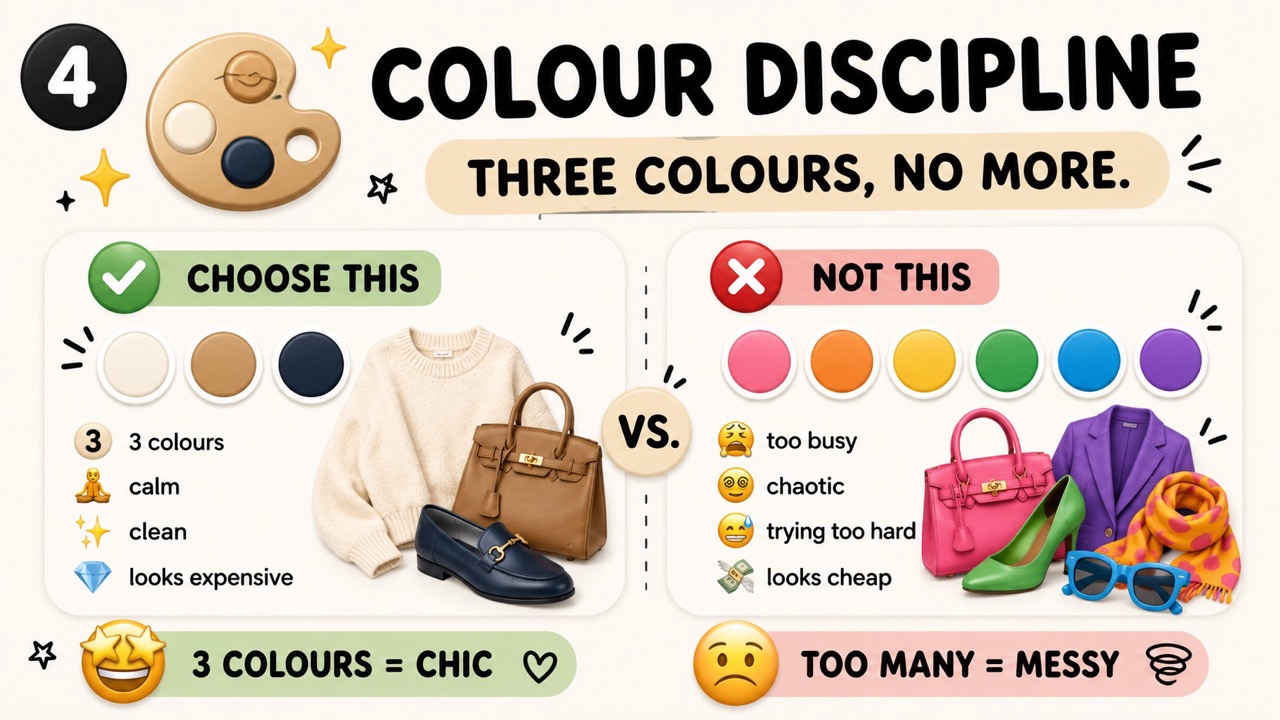
Three colours = chic. Too many = messy. The math is that simple.
There is a reason this works, and it is pure psychology. When everything sits in a tight, restrained palette, your eye reads intention. It reads editorial — like a magazine decided this. The moment you add the fourth and fifth colour, you break that calm, and the brain reads it as accidental. As noise. As cheap.
This is exactly what French women are famous for. They lean classic, they lean elegant, and they keep the palette quiet so the quality of each piece can be seen. The restraint is the luxury.
Before you walk out the door, do one thing: count your colours. If you are past three, take one off. The outfit will not get more boring. It will get more expensive.
|
The full system The Elegant Wardrobe System Every tell, every fix — laid out so you can walk through your own wardrobe piece by piece and know in seconds what reads expensive and what is quietly dragging you down. |
3. The Pristine Signal — Keep It Clean, Keep It Pressed
This is the one almost everyone underestimates, because it has nothing to do with the clothes themselves. It is about their condition.
Pilling on a sweater. A scuffed, rounded-off shoe edge. Whites that have gone slightly grey. A hem that is wrinkled or coming loose. Each one is tiny. Each one is invisible to you because you see these clothes every day. But to everyone else, they add up to a single message: not maintained.
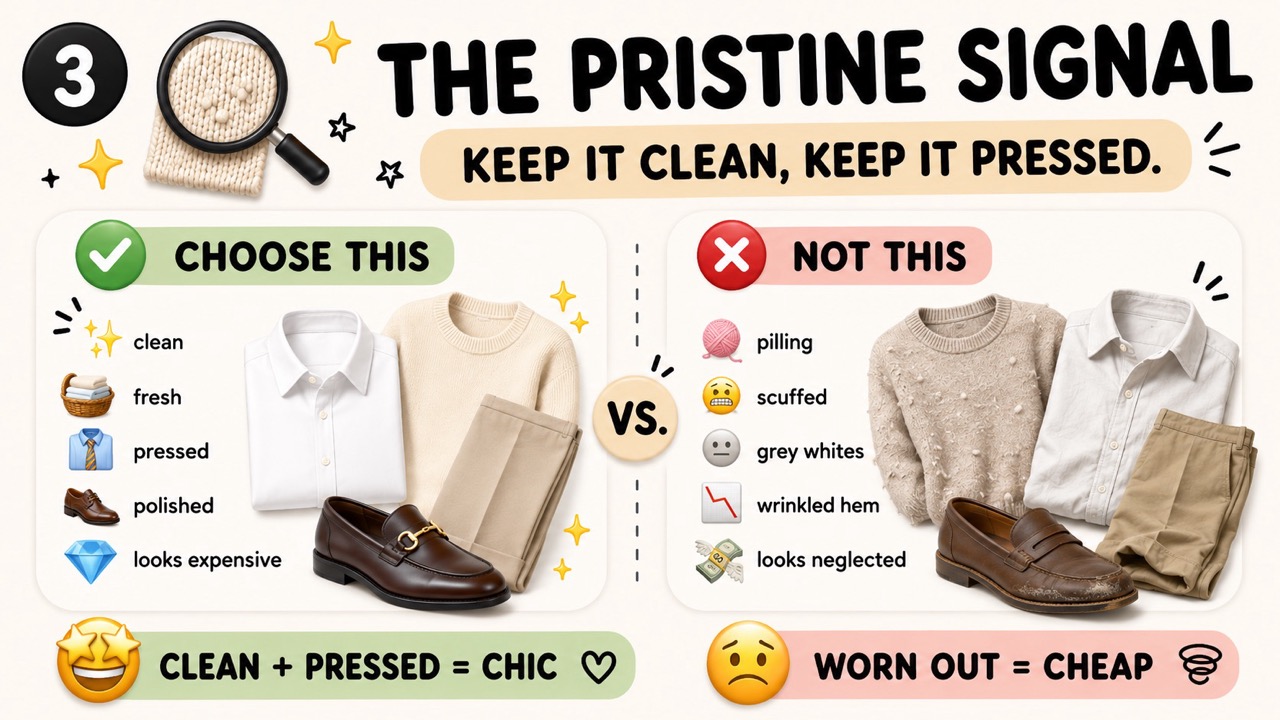
Clean + pressed = chic. Worn out = cheap. Condition is a choice.
And maintenance is the signal. Keeping something pristine takes time, care, and resources. So when your eye lands on a crisp, spotless white — a clean white shirt, white jeans, a pressed white trouser — it reads this woman has the means to keep this perfect. That is status. That is literally why white is the ultimate flex. Anyone can buy white. Almost nobody can keep it pristine. Pulling it off says everything.
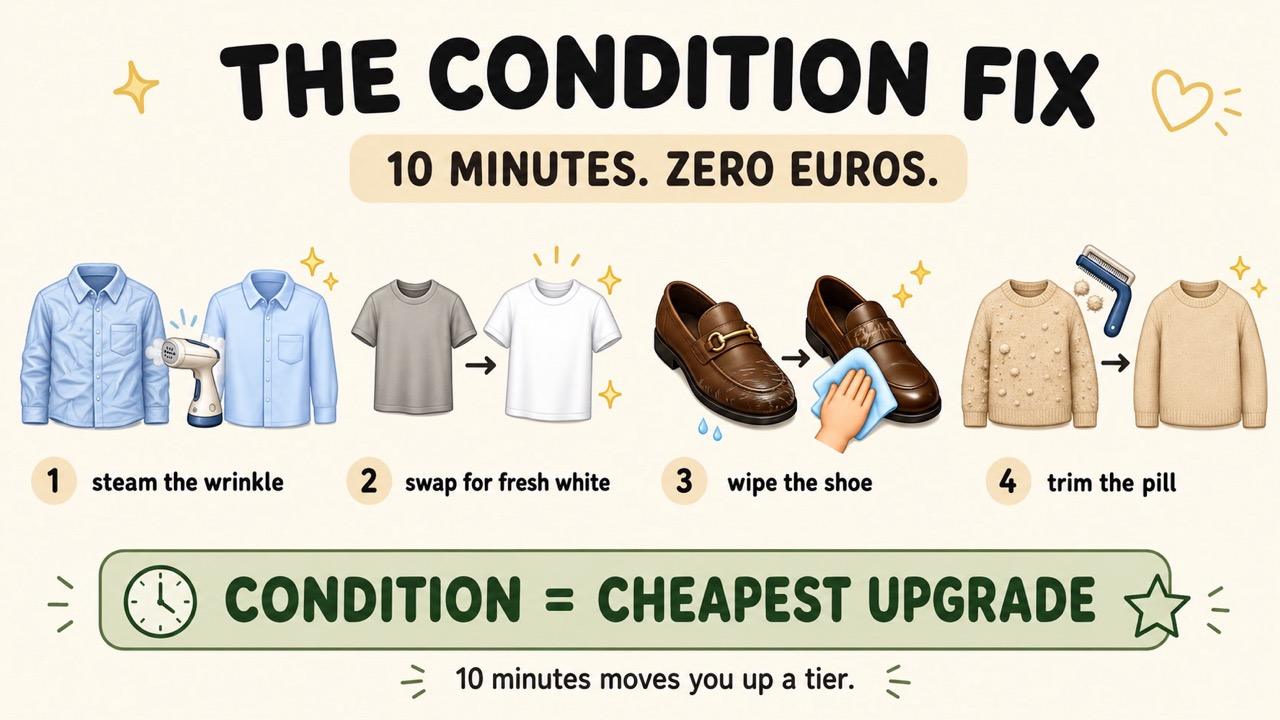
Ten minutes. Zero euros. Moves you up a whole tier.
Steam the wrinkle, swap the greyed tee for a fresh white one, wipe the shoe, trim the pill. Ten minutes. Zero euros. And it moves you up a whole tier. Condition is the cheapest upgrade in fashion — most women never touch it.
|
The 10-minute condition kit Handheld Clothes Steamer → Fabric Shaver → * Affiliate links — I earn a small commission at no cost to you. |
2. The One Anchor — Pour Your Money Into a Single Great Piece
Here is the mistake most women make: they try to make everything in the outfit look expensive — and end up spreading their budget so thin that nothing lands. The women who get it right do the opposite. They pick one object. One credible, expensive-reading piece. And they let it carry the whole look.
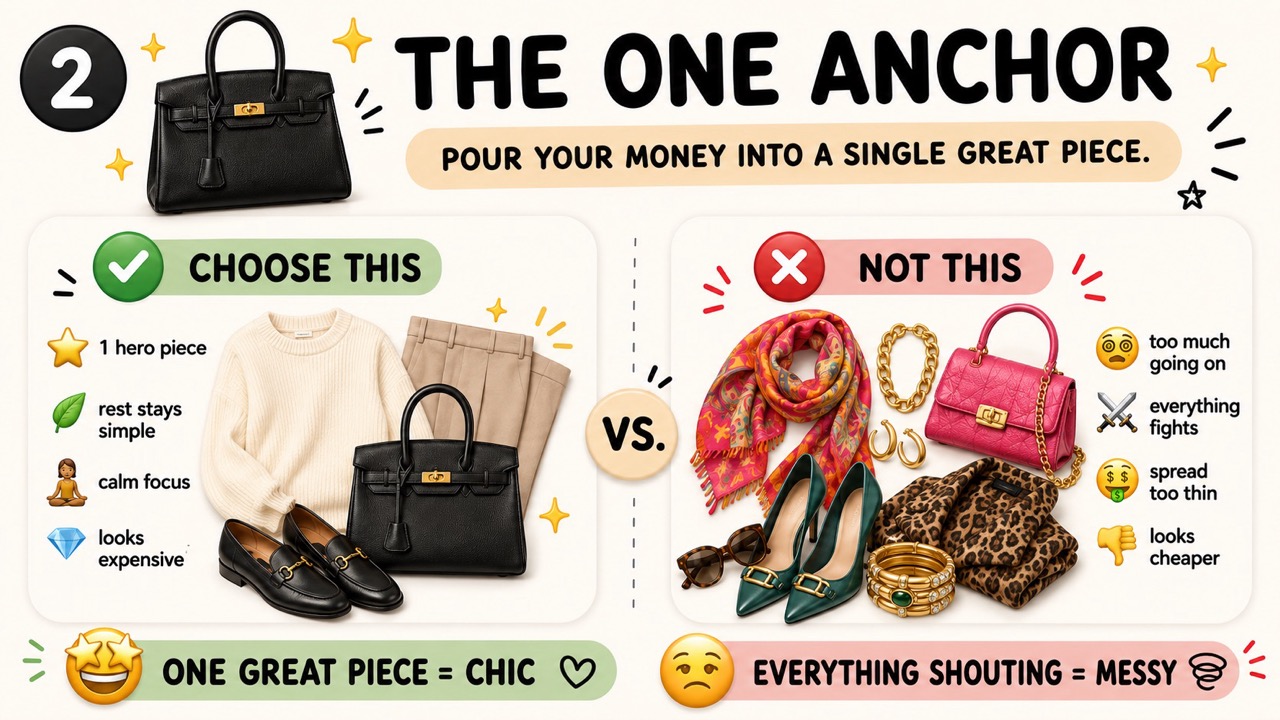
One great piece = chic. Everything shouting = messy.
A structured leather bag that holds its own shape. A woven-leather bag where you can see the craftsmanship. A kitten-heel mule instead of a tired pump. A real leather belt. A matte gold piece, or a single pearl earring. One of those — done well — and the eye does something fascinating.
It anchors. The brain takes the single most expensive-looking element in the frame and quietly assumes the rest of the outfit lives at that level too. One genuinely good bag makes the whole look read up. One collapsing, shiny bag drags the whole look down — even if everything else is beautiful.
If you only invest in one category this year, make it the anchor. It is the highest return on a single purchase in your whole wardrobe.
|
Shop anchor pieces Structured Top-Handle Bag → Woven Leather Bag → Kitten Heel Mules → Real Leather Belt → Freshwater Pearl Earrings → * Affiliate links — I earn a small commission at no cost to you. |
1. The Shoulder Seam — The Fit That Beats Everything
Of everything on this list, this is the one your eye reads first and trusts most — and almost nobody talks about it.
Look at the shoulder of any jacket, blazer, or top. There is a seam where the sleeve meets the body. On a cheap or ill-fitting piece, that seam droops. It sits a centimetre, two centimetres, past where your actual shoulder ends. And the whole garment goes boxy and shapeless below it.
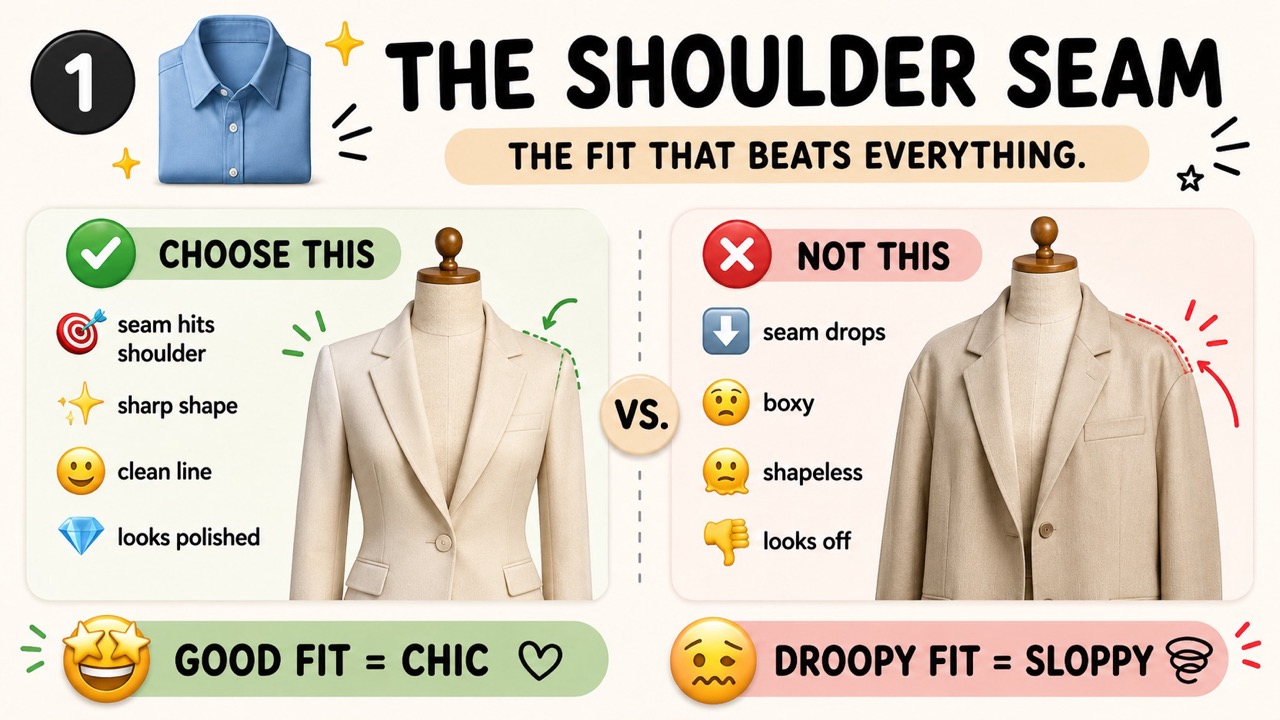
Good fit = chic. Droopy fit = sloppy. The seam tells the whole story.
On an expensive look, that seam sits exactly at the edge of the shoulder bone. Precisely there. And the piece follows the body — a blazer that nips in slightly at the waist instead of hanging straight like a box.
Why does this beat all the others? Because the eye reads structure as architecture, and architecture as investment. A seam in the right place tells your brain the garment was built — cut and constructed for a body. A dropped seam screams off-the-rack, grabbed in a hurry, never altered. It is the difference between a frame that fits the painting and one that doesn’t. We feel it instantly, even when we cannot name it.
The good news: this is fixable on clothes you already own. A tailor can nip a shoulder and take in a waist for very little — and it will transform pieces already hanging in your closet. The shoulder seam is the detail that separates dressed from expensive.
|
Shop fitted blazers with clean shoulder lines Fitted Women’s Blazer → * Affiliate links — I earn a small commission at no cost to you. |
All Five Together
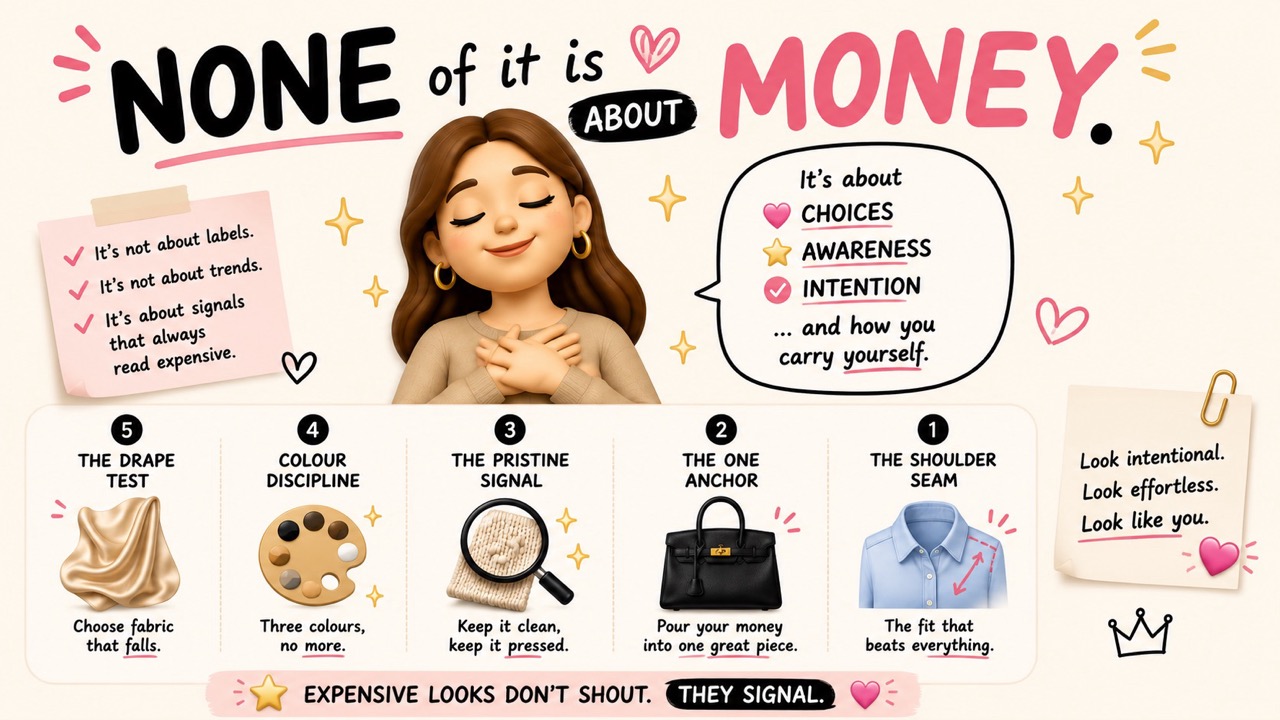
Expensive looks don’t shout. They signal.
None of it is about money. All of it is about attention. Here they are, locked in:
Now that you can see these five, you will see them everywhere — on other people, and, more importantly, in your own mirror. Which one surprised you most? Tell me in the comments — I read every one.
|
For women 40+ The Elegant Wardrobe System The full system for building polished outfits that are easy to repeat — every tell, every fix, for your own closet. |
Disclosure: This post contains affiliate links. As an Amazon Associate I earn a small commission from qualifying purchases, at no extra cost to you. I only link to products I would genuinely recommend.