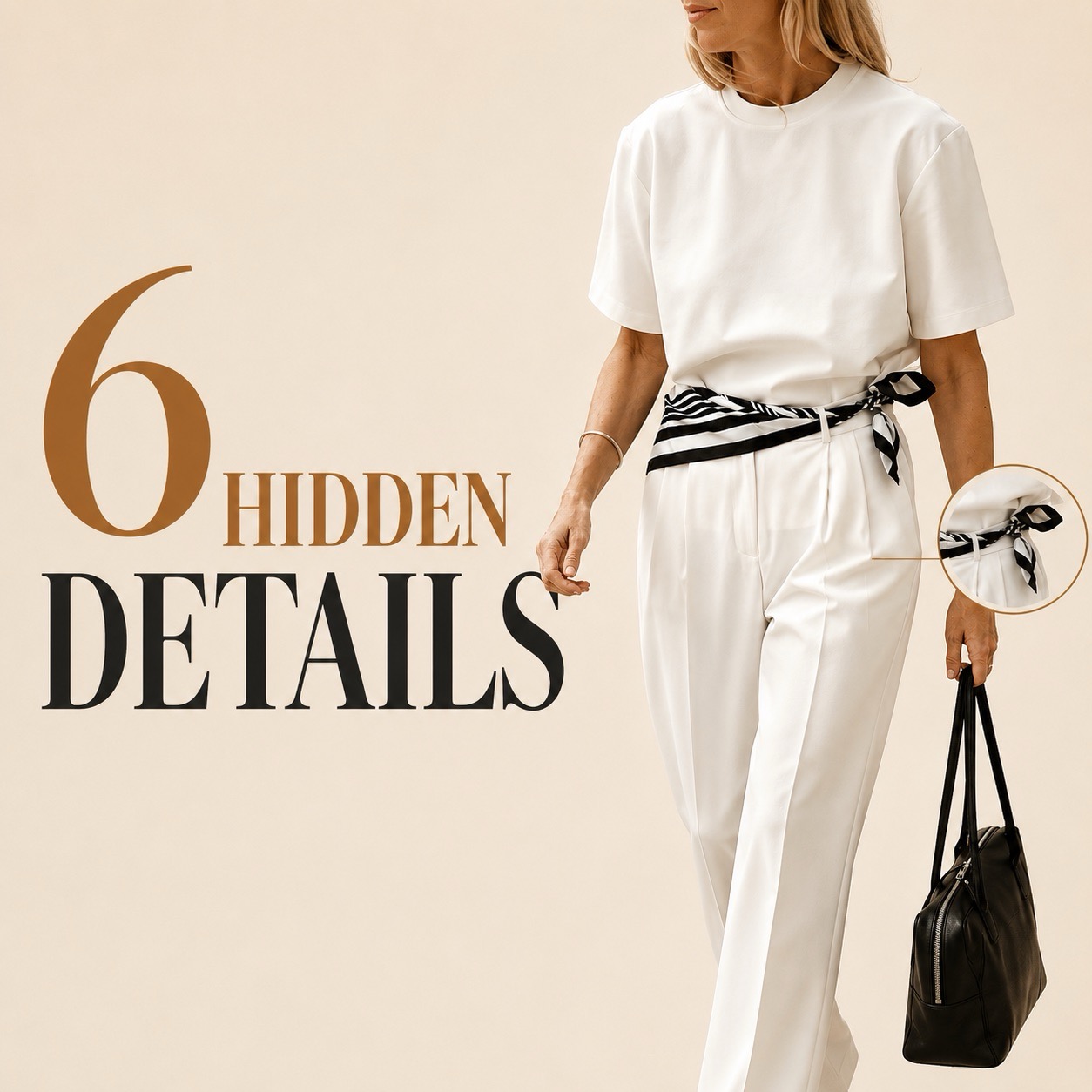
Her outfits look simple — a white tee, a grey knit, a beige trouser. So why does hers read as considered, and yours reads as plain? It isn’t the clothes. It is a set of decisions running underneath. Here are six of them, decoded — every one wearable at 50, at 60, and well beyond.
Most women who love clean, neutral dressing own the right pieces and still land one step short. The tee is white. The trousers are simple. Nothing is wrong. And that, exactly, is the trap — minimalism gets sold as a shorter shopping list, when the women who actually make it look expensive are running a system underneath every outfit.
The creator we’re decoding here — @domi_minimaliststyle — rarely buys anything new. She repeats. She reworks. She wears the same pieces on a loop, and it never looks like less. That is the proof: you only notice how good someone’s eye is when the clothes stop changing and the styling carries the weight. Here are the six things she does — and you can copy every one with what is already in your closet.
OneThe Detail Tax
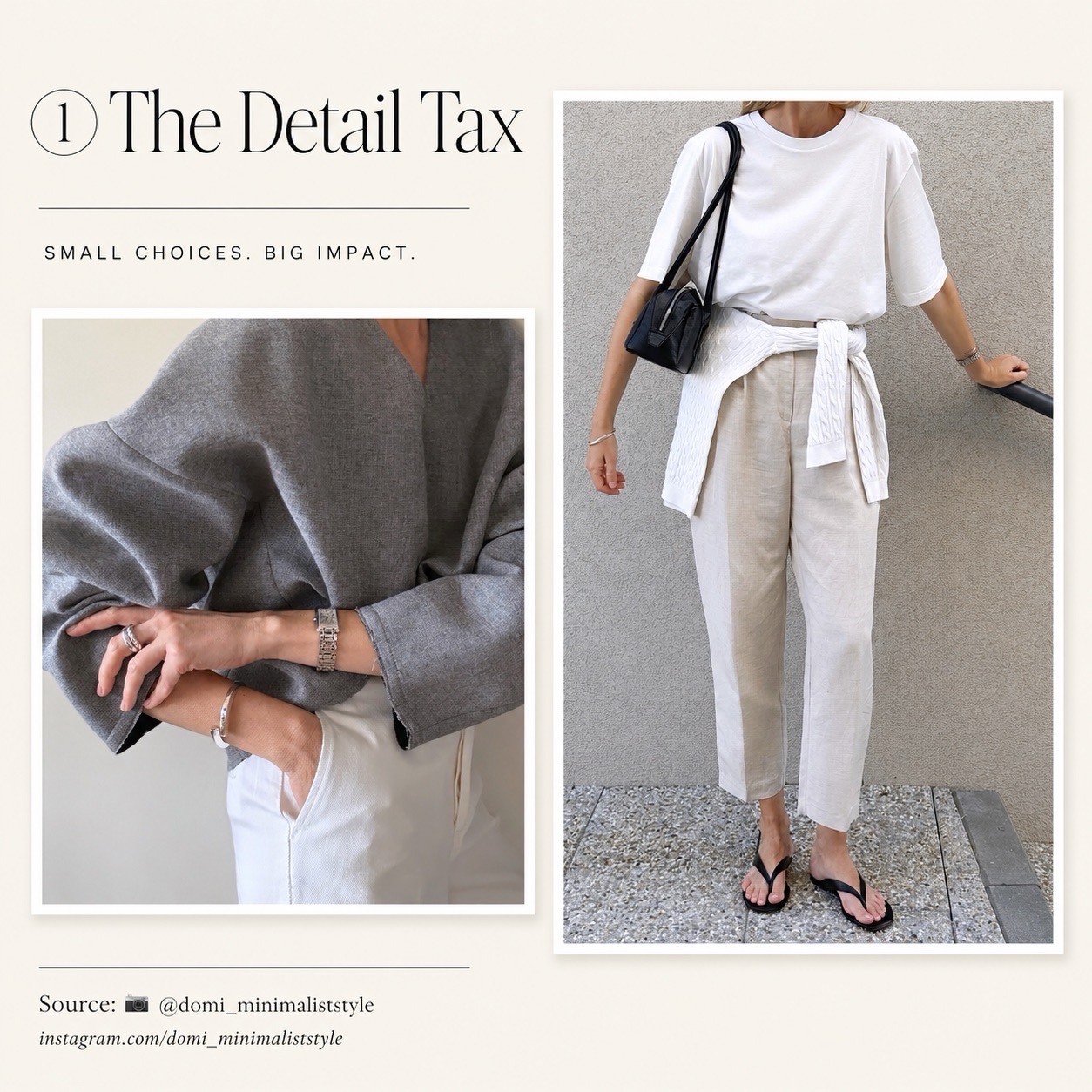
Minimalism does not let you hide. A loud print can be sloppy and get away with it — the pattern does the work. A plain outfit cannot. Strip a look down to a white tee and trousers and there is nowhere for a mistake to go: every wrinkle, every gap at the waist, every sleeve at the wrong length shows. Simple clothes charge you in attention. You either pay it, or the outfit reads unfinished.
Watch how she pays it. The cuff is not buttoned and forgotten — it is folded back to sit at the wrist bone. The tee is not left to hang — it is half-tucked, so the waist has a defined point. A stack of silver rings, one cuff, a slim watch. None of it was bought for the outfit. All of it was decided, in thirty seconds at a mirror. That is the whole gap between her white-on-white and the one in your closet you decided “doesn’t work on you.” It works. It just has not been paid for yet.
Shop the building blocks: heavyweight basic tees · fine basic jumpers
TwoThe Off-Trend Anchor
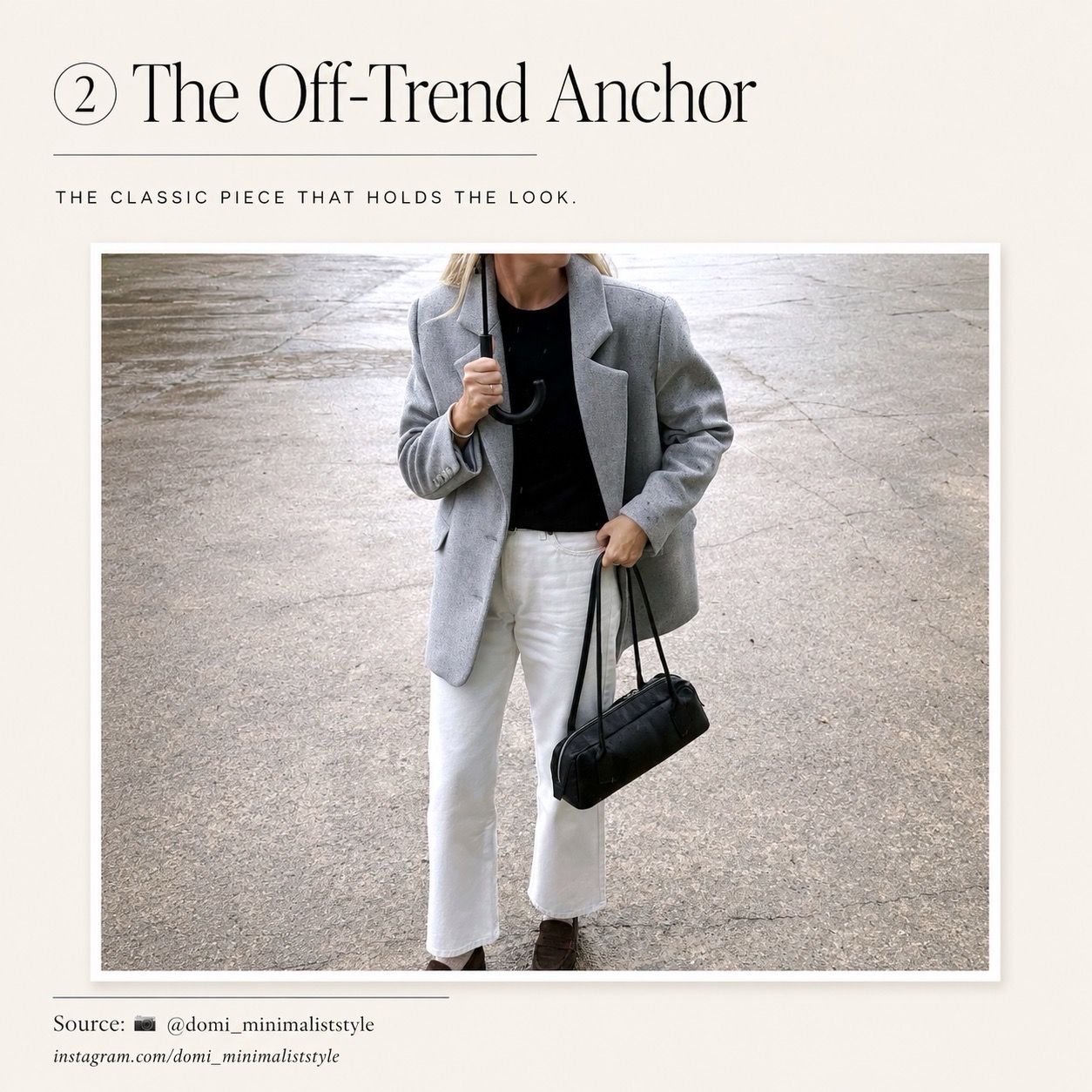
She is current without ever chasing. The barrel-leg trouser, the slouchy bomber, the oversized blazer — she is clearly aware of what is happening now. But she takes the shape and leaves the noise. A trend arrives as a package: the silhouette, plus a colour, plus a logo, plus a styling gimmick that dates it within a year. She unbundles it, and keeps only the part that is a genuine improvement — the proportion.
So her outfits read as modern, but you cannot timestamp them. Pull any photo and you genuinely cannot tell if it is from this year or four years ago. The anchor is almost always a classic, structured piece — a grey blazer, a good coat — worn over the simplest possible base. Nothing she puts on looks tragic in hindsight, because she never went all in on the thing everyone later regretted.
Shop the anchor: oversized blazers
ThreeThe Four-Color Contract
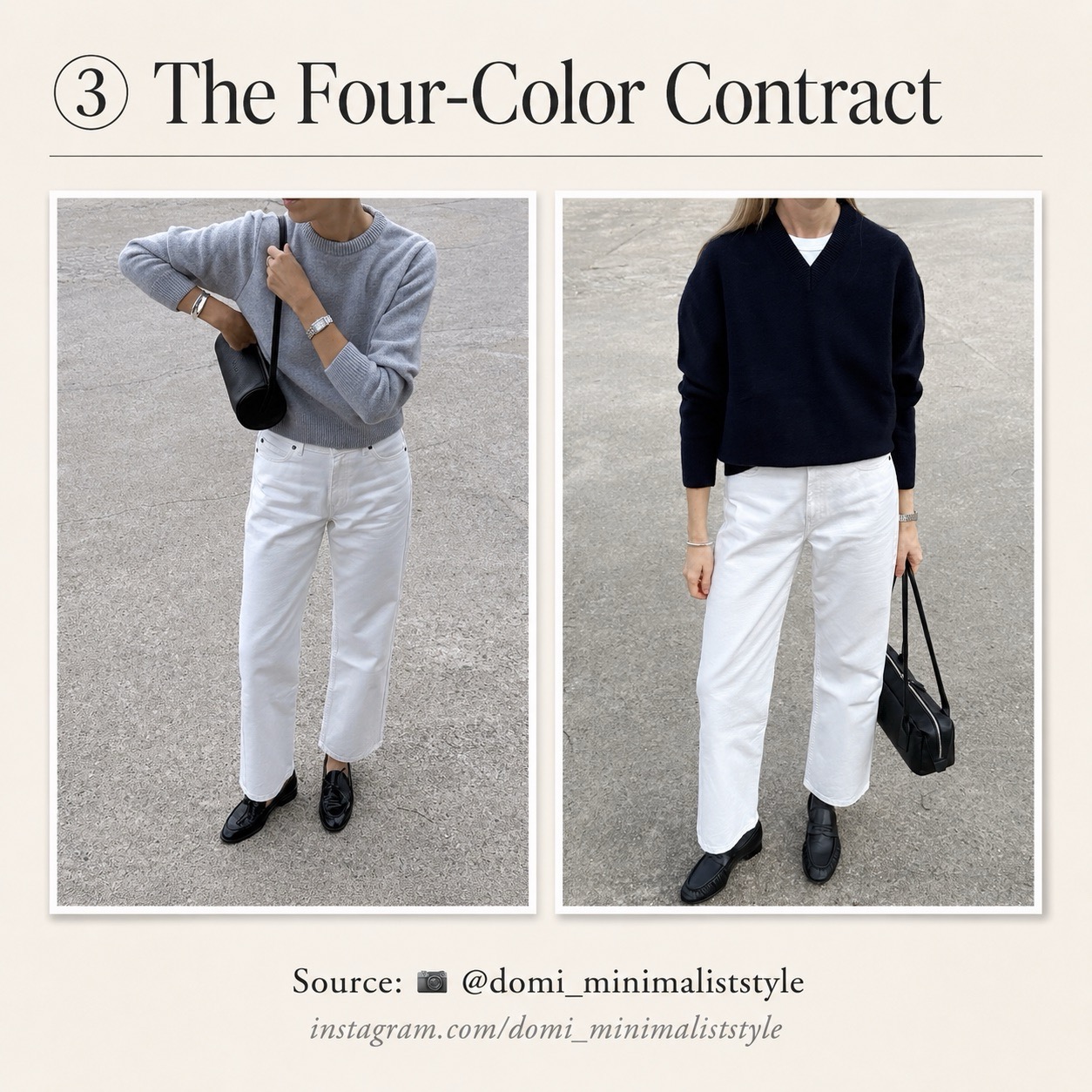
This is the one most people get wrong when they try to copy her. The palette is four colours: black, white, grey, beige — with a soft blue or navy allowed in, rarely, as a guest. That is the whole contract. No burgundy “for autumn,” no olive “as a neutral.” When every piece lives in the same four tones, you cannot build a clashing outfit. It is mechanically impossible. Reach into the closet blind, and whatever comes out works.
People think she has a gift for putting colours together. She does not put colours together — she removed the problem entirely. And the occasional navy is the tell of someone confident: one liberty, used sparingly, landing every time precisely because it is rare. One guest at the table, never a crowd.
Shop the base: white jeans
Every decision on this page comes from one idea: narrow your choices on purpose, so the few that are left are the only ones that matter. The Elegant Wardrobe System walks you through building that exact wardrobe from what you already own — your colours, your shapes, your lane — until getting dressed stops being a decision at all.
Get the Elegant Wardrobe System — $49
One payment. Yours to keep. Built for the woman who already has the clothes.
FourThe Clean Read
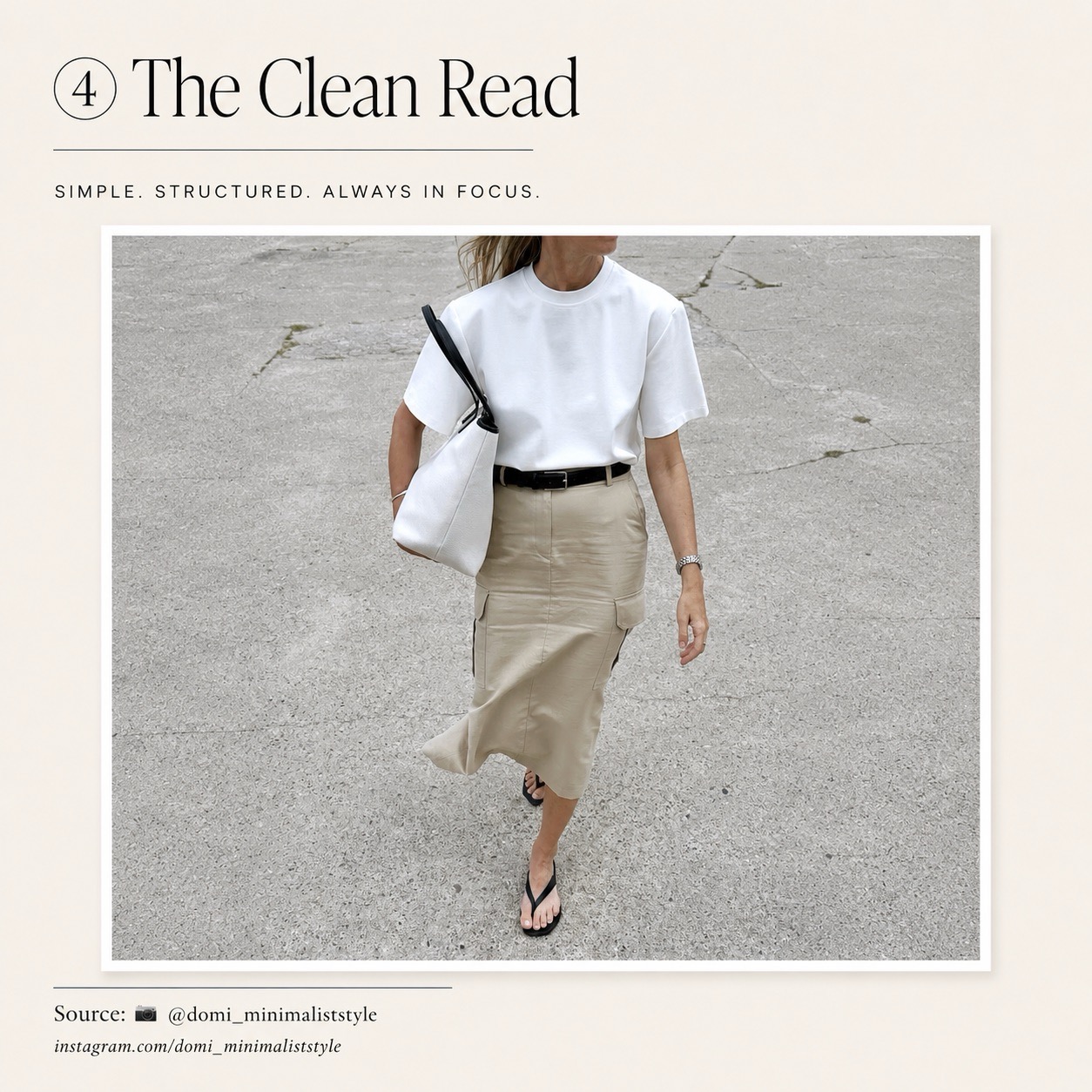
Clean is a technique, not a vibe. The rule underneath it: one outfit, one focal move — never two. Find the single thing your eye lands on. Sometimes it is a sculptural sleeve, sometimes a strong belt cinching a soft trouser, sometimes a chunky silver cuff against bare skin. But it is always one thing. The rest of the outfit goes quiet, so that one element can speak.
The common mistake is layering three interesting things and calling it styled — statement earrings, and a printed scarf, and a textured bag, and a bold shoe — until nothing wins, because everything is shouting. That is what reads as cluttered, even in neutrals. She picks one note and mutes everything around it. The belt only looks sharp because the skirt beneath it is plain.
Shop the shape: cargo skirts
“She doesn’t put colours together. She removed the problem entirely.”
FiveThe Quiet Geometry
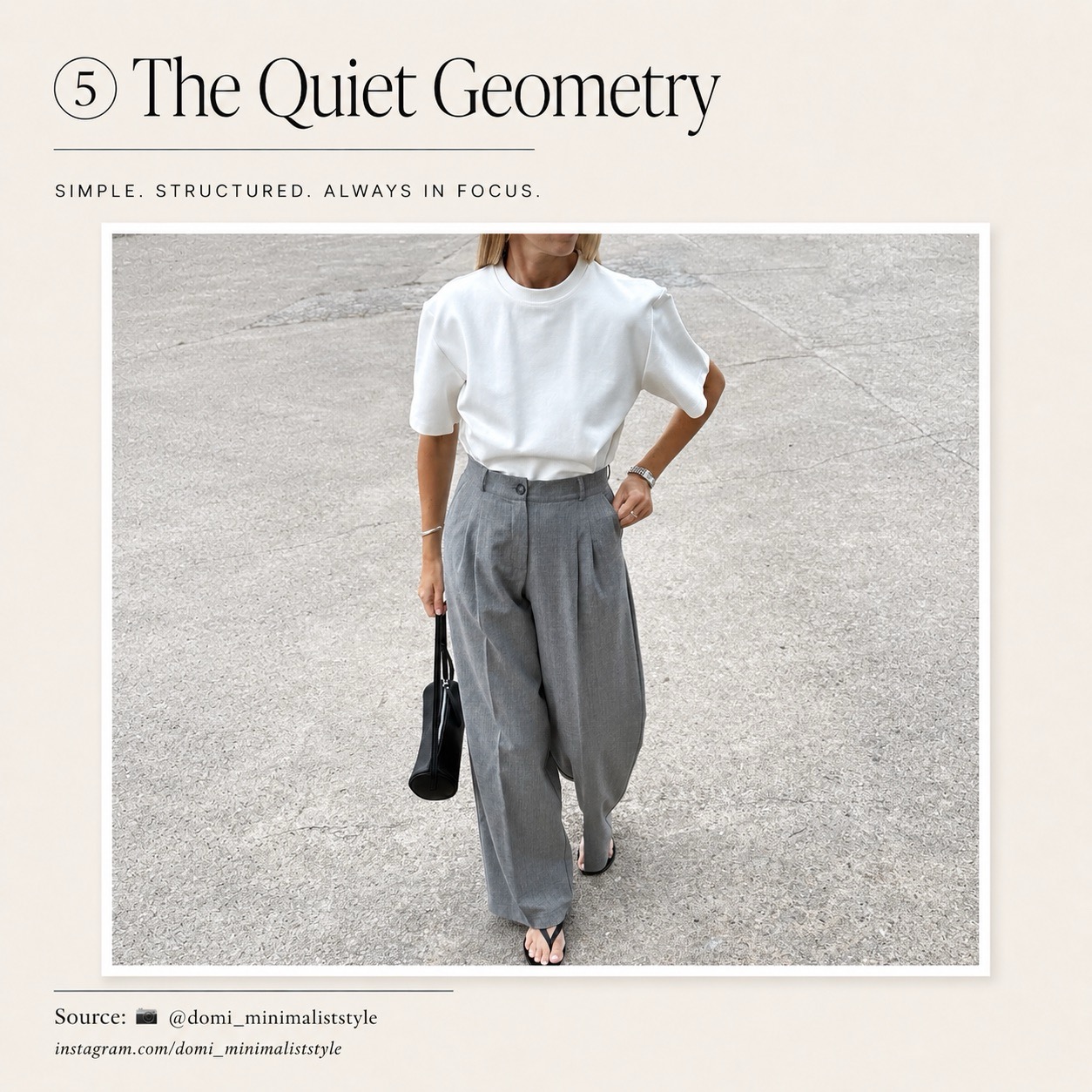
If you are not using colour, you have to create interest somewhere — and she does it through shape. Volume on top, lean on the bottom. A boxy shoulder over a narrow trouser. A long straight coat that turns the whole body into one clean vertical line. A waist nipped hard, so the shape reads as an hourglass instead of a rectangle. She is sculpting.
But the discipline is this: one structural idea at a time. Oversized top, simple bottom. Dramatic wide trouser, fitted plain top. She never stacks volume on volume, never does the big sleeve and the balloon trouser and the giant coat all at once. One geometric statement, simplicity everywhere else — which is how she gets movement and shape without ever tipping into costume.
Shop the shape: wide tailored trousers
SixThe Bounded Risk
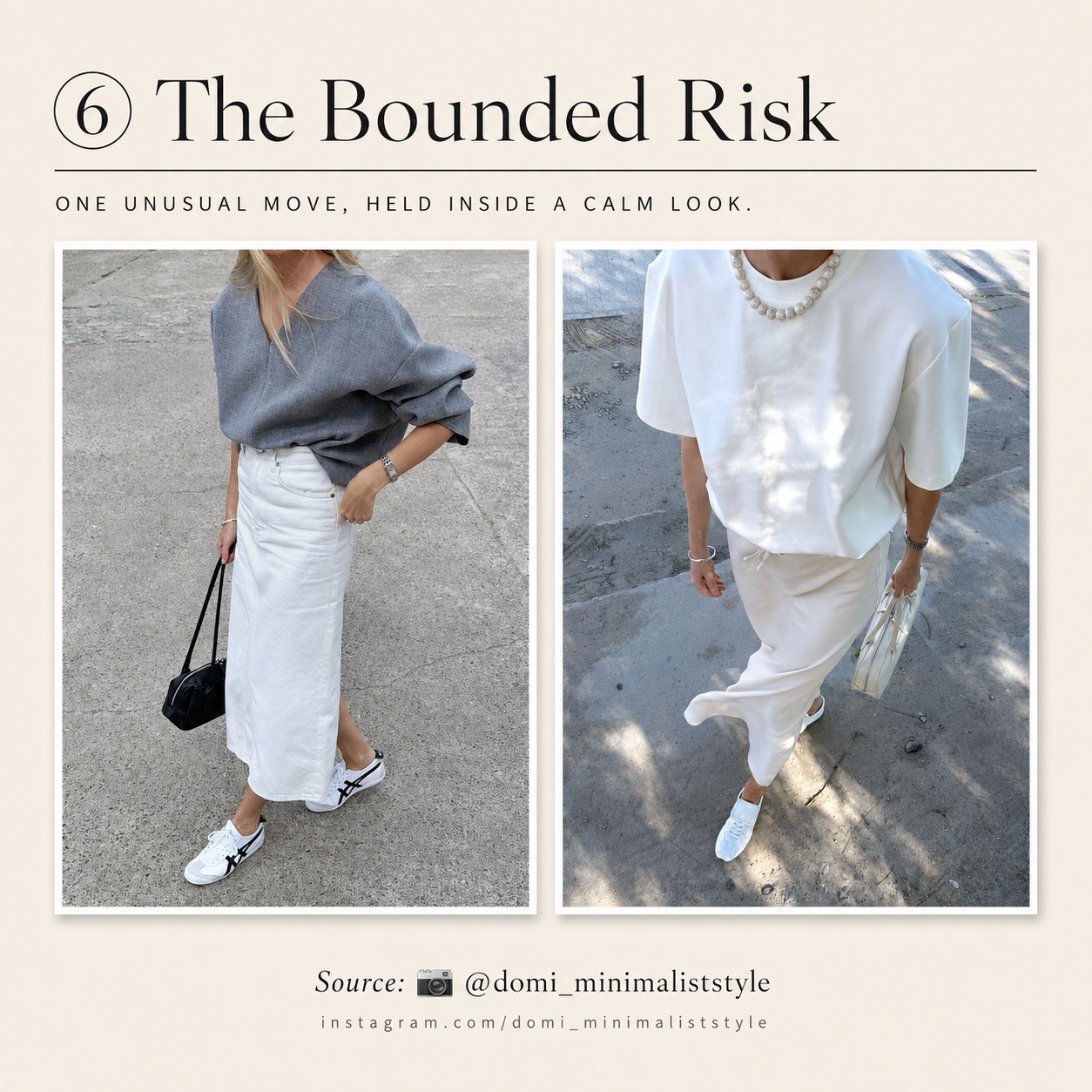
She experiments constantly — a deep back, a tailored vest worn as a top, an unexpected proportion, a sporty sneaker under a soft skirt. But she never seems to fail, because she only ever tests inside her own lane. A risk is usually a gamble because every variable is unfamiliar at once: new colour, new trend, new silhouette. Of course it sometimes flops.
Hers are not gambles, because she changes exactly one thing. New shape? Same four colours, same clean styling, same fabrics she trusts. The only variable in play is the one she is testing; everything around it is locked and known. So even her boldest outfit is ninety per cent familiar. It looks like fearlessness. It is actually structure — a lane built so safe that being brave inside it costs her nothing.
Shop the move: slim retro sneakers
The thing underneath all six
She did not find better clothes. She built a better system. Four colours, signed and closed. One shape at a time. One focal point. Every detail paid for. Every risk taken inside walls she built herself. The pieces were never the point — anyone can buy a white tee.
What she decoded is that minimalism is not about owning less. It is about deciding less — so the few decisions left are the only ones that ever mattered. And that holds at 50, at 60, at any age, because deciding well is the one thing that only sharpens with time.
Add your email and I’ll send the free guide, plus a short series of style notes to help you dress with more ease and elegance. Already subscribed? You don’t need to sign up again.
This post contains affiliate links; if you buy through them I may earn a small commission, at no extra cost to you. Outfit references and images are via @domi_minimaliststyle and shared with permission. Analysis and commentary are my own.