
Your neutrals are fine. The pieces are good, the colours are correct — and still they read flat. Here are the seven quiet rules behind neutrals that never disappear, the way the most elegant European women actually wear them, using what is already in your closet.
This post contains affiliate links, which means Trends Spotted Fashion may earn a small commission if you buy through them, at no extra cost to you.
There is a moment, somewhere after seventy, when the fashion world stops offering you clothes and starts offering you cover. Beige that apologises for taking up space. Or prints loud enough to be mistaken for a personality. Two doors, both marked invisible. The women who look most assured at this age walked past both of them — and they did it with plain, ordinary neutrals.
What follows are seven rules behind a look that is calm and impossible to overlook. None of them cost money. None of them require a single new piece. All of them come down to one decision the industry hopes you never make: to dress deliberately, for your own eye, instead of to disappear politely. Here they are, starting with the one your eye registers before anything else.
Rule OneThe One-Object Rule
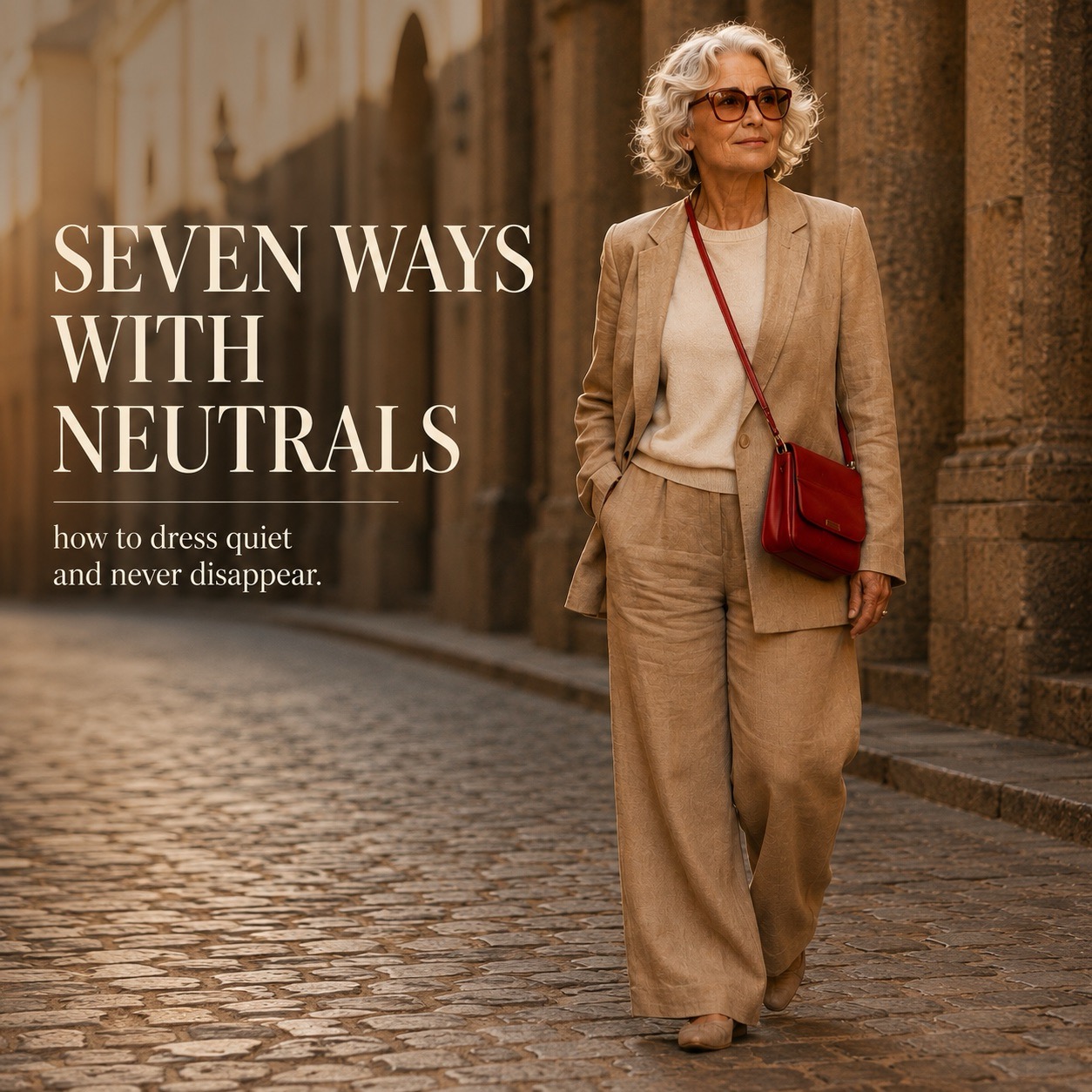
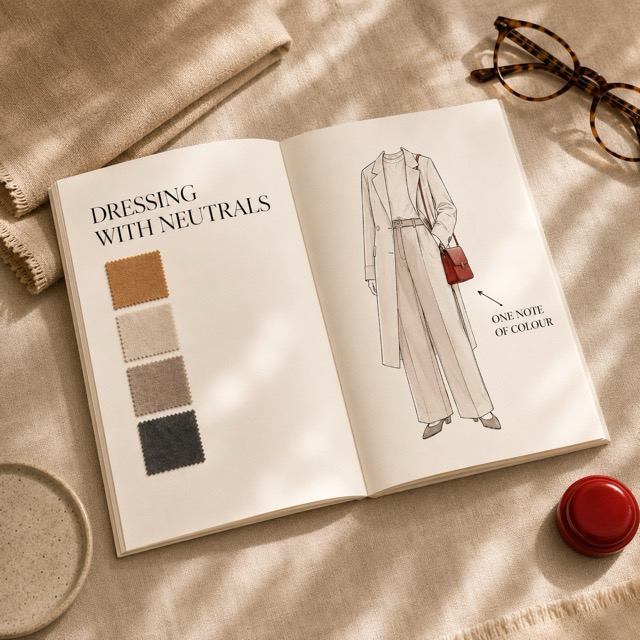
The most common mistake in neutral dressing is not too little colour — it is too many small attempts at it. A scarf here, an earring there, a printed shoe. Given ten small places to look, the eye reads none of them. The fix is the opposite of adding: dress almost entirely in one neutral, then add exactly one object in colour. One. A red bag against head-to-toe camel. The neutrals become the stage, and the single object becomes the performance.
Why one and not three? Because the eye wants somewhere to land. One clear point reads as deliberate — chosen, expensive. Two or three competing points read as nervous, as though permission was asked. So before you add a second colour tomorrow, take the first one off and let it stand alone.
I put all seven rules — and the worked outfit behind each one — into a single, printable infographic you can keep on the wardrobe door. It is free. Add your email and I’ll send it straight over.
Rule TwoThe Colour Commit

There is a second way to use colour, and it looks like the opposite of the first. Sometimes you do not want the quiet — you want the colour to be the outfit. When that happens, the rule is to commit. Not a red top with neutral trousers, but a red blazer, red trousers, red all the way down. A wine suit, the same deep burgundy from collar to hem.
Most women are taught to use colour carefully after a certain age — a pop, a touch, a hint. But the pop is the problem; a small flash of red on beige reads as tentative, as if it were asking to be allowed. A full column of one colour asks no one anything. The trick is tonal discipline: keep it to one red, one temperature, top to bottom, so the eye reads a single column rather than two red items standing near each other. Let the bag go warm and neutral — a cognac, not a second colour event. A full stop.
Rule ThreeThe Texture Read

This is the rule that decides whether your beige reads rich or flat. Dress in a single neutral with no contrast at all — brown on brown, camel from shoulder to shoe — and on paper it should be dull. Done well, it is the most expensive-looking thing in the room. The reason is texture. When you take colour contrast away, the eye stops reading colour and starts reading surface.
So give it surfaces to read. A matte linen against a chunky knit. A smooth tee under a quilted, almost crackled jacket. Suede beside fine leather. Same colour, three textures — and the eye has somewhere to travel. This is why a single-shade outfit never has to disappear: you are not asking colour to do the work, you are asking fabric.
Rule FourThe Neutral Duet
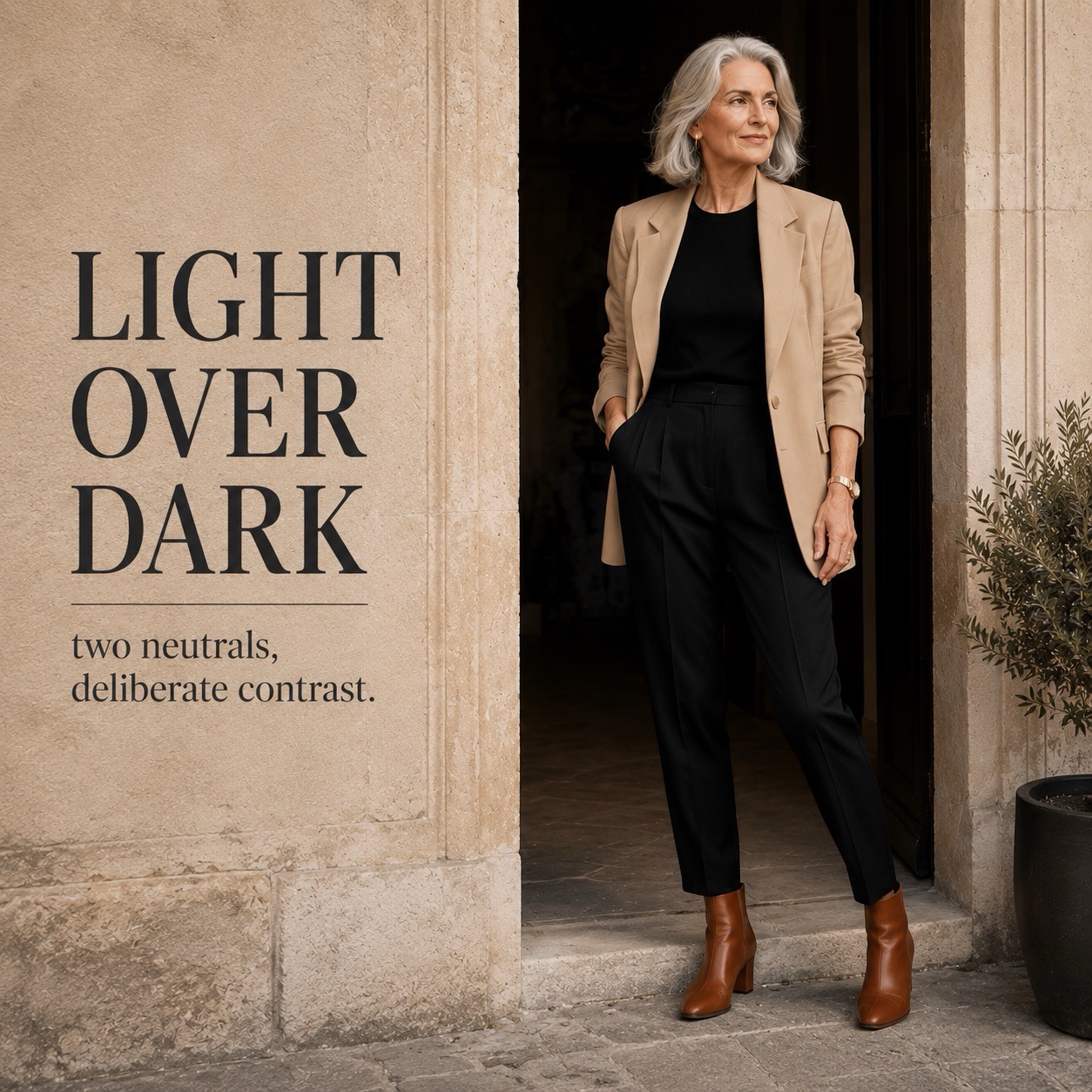
One-colour dressing carries a risk: sometimes it is too quiet. The answer is not colour — it is a second neutral. Take a darker base, a black knit and black trousers, and lay a lighter neutral over the top: a camel blazer. The camel does not match the black. It frames it.
This is the distinction most people miss — you can have contrast without colour. Light against dark. Warm against cool. The same matte in two different weights. And the topper is almost always the lighter one, because a brighter layer over a dark base lifts the whole look up toward the face, which is exactly where you want the eye to go.
“A signature is not built by owning more. It is built by repeating one thing until it belongs to you.”
The free one-page infographic — all seven rules and their worked outfits — is yours just above. Add your email and it lands in your inbox in a couple of minutes.
Want the full method behind the rules? The Elegant Wardrobe System walks you through building a settled, personal wardrobe from what you already own.
Get the Elegant Wardrobe System — $49
Not sure where your neutrals are losing it? Take the free quiz:
Rule FiveThe Single Jewel

Look at how she wears jewellery, and notice mostly what she leaves off. Bare hands. One watch, or nothing. She chooses one piece and lets it be the only ornament in the frame — a full strand of cream pearls against a deep wine knit, and nothing else competing. No bracelets, no stacked rings, no three necklaces fighting for the same inch.
One real piece, worn alone, reads as a choice. The same pearls under three other necklaces read as clutter. And there is a quieter reward: wear one piece again and again, and it stops being a necklace and starts being yours. People stop seeing the jewellery and start seeing you in it. That is how a signature is made.
Rule SixThe Pattern Sliver
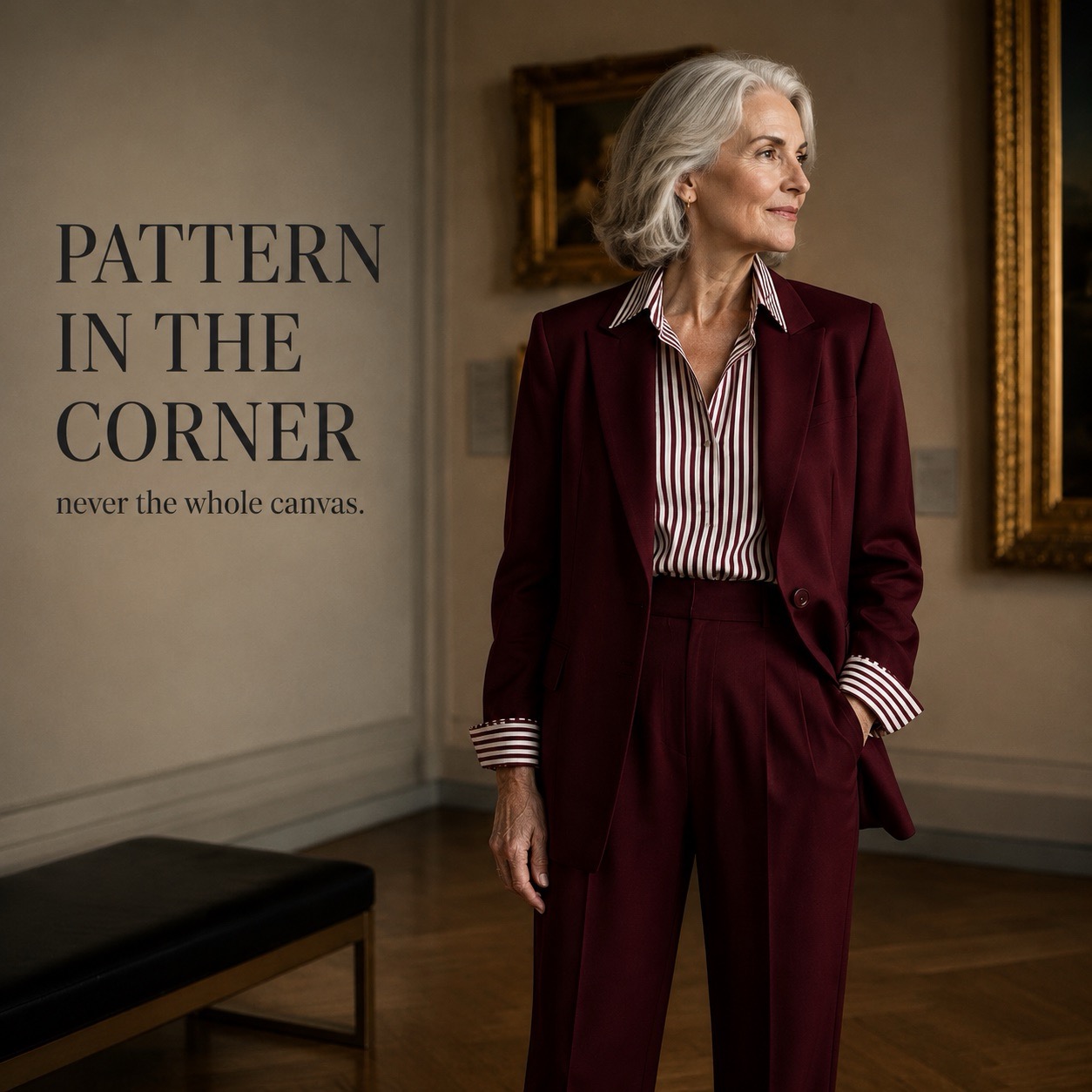
Pattern is not forbidden here — it is simply kept on a leash. Stripes, leopard, the occasional paisley, but never as the whole outfit. Pattern lives in one small window and nowhere else: the collar and cuffs of a striped shirt under a solid suit, a sliver showing at the neck and the wrist.
An all-cream outfit with the only pattern on the feet — a single leopard flat. A solid navy column broken by one Breton-striped knit. The pattern is never the canvas; it is the signature in the corner. This is what lets a woman who loves print stay in charge of it: find the one pattern you love, and give it the smallest, sharpest place in the outfit. A little pattern, placed exactly, does more than a lot of pattern everywhere.
Rule SevenThe Frame

The last one is the thing you notice first, before any outfit — the glasses. Bold, architectural frames, large and unapologetic, never the thin invisible kind chosen to disappear. Most eyewear after sixty is sold on the promise that you will barely know it is there. She does the reverse: she treats the frame as the one strong feature she wears near her face, every single day.
It does the work a bold lip or a large earring does for someone else. And because it never changes, it becomes the most recognisable thing about her — the silver bob, the strong frame, known across a room from the eyebrows up. A signature is one or two things you repeat until they are unmistakably yours. Find your two. Repeat them on purpose.
The thing underneath all seven
One idea sits beneath every rule above: none of this is about spending more. Not one of the seven needs a new piece or a bigger budget. The goal was never to be appropriate — never to fade politely into beige, or to overcompensate with noise. It is to be deliberate. To choose less, and mean it more.
That is what expensive actually is — not a price, not a label, but a set of decisions worn without explanation. At seventy-four, she is not dressing for her age. She is dressing like a woman who decided, somewhere along the way, that she had earned the right to be seen exactly as she is. You have earned it too. That part was always yours.
References to European dressing are for commentary and analysis. All imagery here is artificially generated. This post contains affiliate links.